Sunday, October 20, 2019

John Henry Newman’s "acceptance of non-Christian religions”


A couple of days ago, whilst engaged in research concerning some enigmatic statements contained within Newman’s  An Essay on the Development of Christian Doctrine, I found a provocative article by Matthew Ramsay titled, “Ex Umbris: Newman’s New Evangelization”, which is germane to my investigation into those statements. Ramsay’s article seems to be an attempt to justify Newman’s overall, positive acceptance of non-Christian religious thought and practice in his apologetic methodology.

[PDF copy available via THIS LINK.]

From the opening abstract, we read:

This article investigates Newman’s arguments for Christianity in light of his acceptance of non-Christian religions. Drawing primarily on the Grammar of Assent and the Oxford University Sermons, as well as Newman’s poetry, prayers, and other works, I argue that Newman’s acceptance of other religions forms the foundation of his Christian apologetic. I first look at Newman’s view of non-Christian religions, where he sees an ascending movement of humanity searching for God and a descending movement of God revealing himself to humanity. (Page 1)

On the next page, Ramsay wrote:

Cardinal Avery Dulles has argued that “Newman made a major contribution by bringing out the importance of what he called ‘natural religion’ as a presupposition for the effectiveness of any demonstratio christiana.” Against the prevailing apologetics of Italian manuals, which attempted to convert by sheer logic, Newman developed a holistic apologetic that sees Christianity as the fulfillment of humanity’s natural religious inclinations. (Page 2)

He then lists four elements concerning Newman’s argument for religious faith:

Newman argued, first, that religion can be good and true outside of Christian revelation; second, that even in non-religious assent, people are not convinced by reason alone; third, that assent to Christianity models other types of assent, which means that religious knowledge outside of Christianity provides the foundation of conversion to Christianity; and finally that the New Testament provides examples of evangelization that follows this model. (Ibid.)

Towards the end of his article, Ramsay advances the following:

Newman’s apologetic is essentially based on two convictions: religious faith is rooted in natural religion, and we are not convinced by reason alone. True natural religion comes from the ascending movements of reason, conscience, and an innate desire for God, and from the descending movement of God’s wide action throughout the world. Assent in all matters of life comes from experience, prior beliefs, and internal convictions rather than reason alone. Religious conversion, then, is rooted in prior religious knowledge and practice, and Christianity is the fulfillment of religious truth already believed and lived.

Because conversion is a movement from partial to fuller truth, a Christian must be willing to recognize truth and goodness outside Christianity. This recognition is not a denial of the centrality of Christ but an affirmation of God’s power and action throughout history. Nor is it a rejection of evangelization. Truth in umbris et imaginibus seeks fulfillment in the One who is “the way, and the truth, and the life” (John 14:6). (Page 18)

[The above brings to mind the Vatican II document Nostra Aetate, wherein we read: The Catholic Church rejects nothing that is true and holy in these religions. She regards with sincere reverence those ways of conduct and of life, those precepts and teachings which, though differing in many aspects from the ones she holds and sets forth, nonetheless often reflect a ray of that Truth which enlightens all men. Indeed, she proclaims, and ever must proclaim Christ "the way, the truth, and the life" (John 14:6), in whom men may find the fullness of religious life, in whom God has reconciled all things to Himself.]

Though Ramsay’s article has been a useful aid in my ongoing study of the recently sainted John Henry Newman, I am still left pondering over the following selections from his pen:

I do not know when I first learnt to consider that Antiquity was the true exponent of the doctrines of Christianity and the basis of the Church of England; but I take it for granted that the works of Bishop Bull, which at this time I read, were my chief introduction to this principle. The course of reading, which I pursued in the composition of my volume, was directly adapted to develop it in my mind. What principally attracted me in the ante-Nicene period was the great Church of Alexandria, the historical centre of teaching in those times. Of Rome for some centuries comparatively little is known. The battle of Arianism was first fought in Alexandria; Athanasius, the champion of the truth, was Bishop of Alexandria; and in his writings he refers to the great religious names of an earlier date, to Origen, Dionysius, and others, who were the glory of its see, or of its school. The broad philosophy of Clement and Origen carried me away; the philosophy, not the theological doctrine; and I have drawn out some features of it in my volume, with the zeal and freshness, but with the partiality, of a neophyte. Some portions of their teaching, magnificent in themselves, came like music to my inward ear, as if the response to ideas, which, with little external to encourage them, I had cherished so long. These were based on the mystical or sacramental principle, and spoke of the various Economies or Dispensations of the Eternal. I understood these passages to mean that the exterior world, physical and historical, was but the manifestation to our senses of realities greater than itself. Nature was a parable: Scripture was an allegory: pagan literature, philosophy, and mythology, properly understood, were but a preparation for the Gospel. The Greek poets and sages were in a certain sense prophets; for "thoughts beyond their thought to those high bards were given." (Apologia Pro Vita Sua, 1865/1945, pp. 17, 18 – bold emphasis mine.)

There are various revelations all over the earth which do not carry with them the evidence of their divinity. Such are the inward suggestions and secret illuminations granted to so many individuals; such are the traditionary doctrines which are found among the heathen, that "vague and unconnected family of religious truths, originally from God, but sojourning, without the sanction of miracle or a definite home, as pilgrims up and down the world, and discernible and separable from the corrupt legends with which they are mixed, by the spiritual mind alone. (An Essay on the Development of Christian Doctrine, 1878/1989, p. 79 - bold emphasis mine.)

There is in truth a certain virtue or grace in the Gospel which changes the quality of doctrines, opinions, usages, actions, and personal characters when incorporated with it, and makes them right and acceptable to its Divine Author, whereas before they were either infected with evil, or at best but shadows of the truth. This is the principle, above spoken of, which I have called the Sacramental.  (Ibid. p. 368 - bold emphasis mine.)

Confiding then in the power of Christianity to resist the infection of evil, and to transmute the very instruments and appendages of demon-worship to an evangelical use, and feeling also that these usages had originally come from primitive revelations and from the instinct of nature, though they had been corrupted ; and that they must invent what they needed, if they did not use what they found ; and that they were moreover possessed of the very archetypes, of which paganism attempted the shadows; the rulers of the Church from early times were prepared, should the occasion arise, to adopt, or imitate, or sanction the existing rites and customs of the populace, as well as the philosophy of the educated class. (Ibid. pp. 371, 372 - bold emphasis mine.)

In the course of the fourth century two movements or developments spread over the face of Christendom, with a rapidity characteristic of the Church ; the one ascetic, the other ritual or ceremonial. We are told in various ways by Eusebius, that Constantine, in order to recommend the new religion to the heathen, transferred into it the outward ornaments to which they had been accustomed in their own. It is not necessary to go into a subject which the diligence of Protestant writers has made familiar to most of us. The use of temples, and these dedicated to particular saints, and ornamented on occasions with branches of trees; incense, lamps, and candles; votive offerings on recovery from illness ; holy water ; asylums ; holydays and seasons, use of calendars, processions, blessings on the fields ; sacerdotal vestments, the tonsure, the ring in marriage, turning to the East, images at a later date, perhaps the ecclesiastical chant, and the Kyrie Eleison, are all of pagan origin, and sanctified by their adoption into the Church. (Ibid. p. 373, - bold emphasis mine.)

After relating the replacement of festivals, rites, shrines and temples dedicated to pagan gods and heroes with Christian martyrs, Newman then writes:

The introduction of Images was still later, and met with more opposition in the West than in the East. It is grounded on the same great principle which I am illustrating; and as I have given extracts from Theodoret for the developments of the fourth and fifth centuries, so will I now cite St. John Damascene in defence of the further developments of the eighth.

"As to the passages you adduce," he says to his opponents, "they abominate not the worship paid to our Images, but that of the Greeks, who made them gods. It needs not therefore, because of the absurd use of the Greeks, to abolish our use which is so pious. Enchanters and wizards use adjurations, so does the Church over its Catechumens; but they invoke devils, and she invokes God against devils. Greeks dedicate images to devils, and call them gods; but we to True God Incarnate, and to God's servants and friends, who drive away the troops of devils." Again, "As the holy Fathers overthrew the temples and shrines of the devils, and raised in their places shrines in the names of Saints and we worship them, so also they overthrew the images of the devils, and in their stead raised images of Christ, and God's Mother, and the Saints. And under the Old Covenant, Israel neither raised temples in the name of men, nor was memory of man made a festival; for, as yet, man's nature was under a curse, and death was condemnation, and therefore was lamented, and a corpse was reckoned unclean and he who touched it; but now that the Godhead has been combined with our nature, as some life-giving and saving medicine, our nature has been glorified and is trans-elemented into incorruption. Wherefore the death of Saints is made a feast, and temples are raised to them, and Images are painted ... For the Image is a triumph, and a manifestation, and a monument in memory of the victory of those who have done nobly and excelled, and of the shame of the devils defeated and overthrown." (Ibid. pp. 376, 377 - bold emphasis mine.)

Back to my studies…


Grace and peace,

David

Tuesday, September 24, 2019

Development of doctrine, Dignitatis Humanae, and the Christianizing of paganism vs. the paganizing of Christianity


This new post has its genesis via the seeds planted from my reading—and related research—of THIS RECENT COM BOX POST by Rory, and his subsequent posts in the same thread. Rory has brought to my attention—what appears to be—contradictions concerning the issue of Church and State relations as delineated in the Vatican II document Dignitatis Humanae, with contributions from previous Popes, theologians, and Catholic kings—e.g. Pius IX, Pius X, Augustine, and Louis IX. (Though not mentioned by Rory in his posts, one could add Pope Leo XIII’s, Immortale Dei—On The Christian Constitution of Statesto his list of previous documents which seem to be contradicted by Dignitatis Humanae.)

Now, after reading Dignitatis Humanae; Augustine’s Letter to Boniface, On the Treatement of the Donatists (#185), and his Letter to Vincent (#93 – also concernng the Donatists); Louis IX's Letter to his son [link]; Leo XIII’s Immortale Dei; Ratzinger’s “EPILOGUE – ON THE STATUS OF CHURCH AND THEOLOGY TODAY” (pages 365-393 in his book, Principles of Catholic Theology); and a number of germane online contributions, I have reached somewhat of an impasse—both sides of the issue have strong arguments for their respective positions. I have become convinced that the side one chooses between the two polarized positions depends on one's understanding of the development of doctrine.

As such, I have once again turned to John Henry Newman’s, An Essay on the Development of Christian Doctrine. This new reading has raised some concerns that went unnoticed in my past readings. I started this new reading using the original 1845 version that I had downloaded to my tablet, and the following caught my eye:

Now there was this cardinal distinction between Christianity and the religions and philosophies by which it was surrounded, nay even the Judaism of the day, that it referred all truth and revelation to one source, and that the Supreme and Only God. Pagan rites which honoured one out of ten thousand deities ; philosophies which scarcely taught any source of revelation at all; Gnostic heresies which were based on Dualism, adored angels, or ascribed the two Testaments to distinct authors, could not regard truth as one, unalterable, consistent, imperative, and saving. But Christianity started with the principle that there was but "one God and one Mediator," and that He, "who at sundry times and in divers manners spake in time past unto the fathers by the Prophets, had in these last days spoken unto us by His Son." Hence Christianity, and it alone, revered and protected the Divine word which it had received, as both sacred and as sanctifying. It was grace, and it was truth. (1845 - p. 338)

So far, so good; I fully affirm all the above. But in the paragraph that immediately follows the above, a ‘red-flag’ went up:

In other words, Christianity has from first to last kept fixed principles in view in the course of its developments, and thereby has been able to incorporate doctrine which was external to it without losing its own. Such continuity of principle, and such assimilating power, are each of them incompatible with the idea of a corruption, as was laid down in an early part of the Volume. The two special principles which the foregoing paragraph introduces, may be called the Dogmatic and the Sacramental, and their assimilating power shall now be illustrated. (1845 - pp. 338, 339)

The notion that Christianity, “has been able to incorporate doctrine which was external to it without losing its own”, seemed a bit out of place to me, so I pulled the 1878 edition off of the shelf, and found the above paragraph missing. I also noticed that the first paragraph I cited above was altered, substituting, “Hence Christianity, and it alone, revered and protected the Divine word which it had received, as both sacred and as sanctifying”, with:

He had never left Himself without witness, and now He had come, not to undo the past, but to fulfil and perfect it. His Apostles, and they alone, possessed, venerated, and protected a Divine Message, as both sacred and sanctifying; and, in the collision and conflict of opinions, in ancient times or modern, it was that Message, and not any vague or antagonist teaching, that was to succeed in purifying, assimilating, transmuting, and taking into itself the many-coloured beliefs, forms of worship, codes of duty, schools of thought, through which it was ever moving. (1878 – pp. 356, 357)

The 1878 edition in the above section has expanded the notion that developments had the ability, “to incorporate doctrine which was external to without losing its own”, to include, purifying, assimilating, transmuting, and taking into itself the many-coloured beliefs, forms of worship, codes of duty, schools of thought, through which it was ever moving.

Unlike my previous readings, I was now quite focused on identifying those, “many-coloured beliefs, forms of worship, codes of duty, schools of thought”, that Newman had in mind. Just a few pages later we read, “St. Augustine might first be opposed to the employment of force in religion, and then acquiesce in it” (1878 – p. 367). In essence, the Church which had been outlawed and persecuted, had now adopted the “code of duty" of Her persecutor. [Is this a case of the Christianizing of paganism, or the paganizing of Christianity—more as this issue later.]

Newman follows the above with:

Confiding then in the power of Christianity to resist the infection of evil, and to transmute the very instruments and appendages of demon-worship to an evangelical use, and feeling also that these usages had originally come from primitive revelations and from the instinct of nature, though they had been corrupted ; and that they must invent what they needed, if they did not use what they found ; and that they were moreover possessed of the very archetypes, of which paganism attempted the shadows; the rulers of the Church from early times were prepared, should the occasion arise, to adopt, or imitate, or sanction the existing rites and customs of the populace, as well as the philosophy of the educated class. (1878 – pp. 371, 372.)

Newman then goes on to provide a number of actual examples of the above outlined principles:

In the course of the fourth century two movements or developments spread over the face of Christendom, with a rapidity characteristic of the Church ; the one ascetic, the other ritual or ceremonial. We are told in various ways by Eusebius, that Constantine, in order to recommend the new religion to the heathen, transferred into it the outward ornaments to which they had been accustomed in their own. It is not necessary to go into a subject which the diligence of Protestant writers has made familiar to most of us. The use of temples, and these dedicated to particular saints, and ornamented on occasions with branches of trees; incense, lamps, and candles; votive offerings on recovery from illness ; holy water ; asylums ; holydays and seasons, use of calendars, processions, blessings on the fields ; sacerdotal vestments, the tonsure, the ring in marriage, turning to the East, images at a later date, perhaps the ecclesiastical chant, and the Kyrie Eleison, are all of pagan origin, and sanctified by their adoption into the Church. (1878 – p. 373 – bold emphasis mine.)

I shall now end this post with two questions: first, if all the above pagan elements can be, “sanctified by their adoption into the Church”, why not the secular humanistic elements found in Dignitatis Humanae? And second, is it possible that a number of the pagan elements that have been adopted by the Church are corruptions rather than true developments—i.e a paganizing of Christianity rather than a Christianizing of paganism?


Grace and peace,

David

Saturday, August 10, 2019

The Devil in the City of Angels


I am a subscriber to Saint Joseph Communications, and over the last few weeks had been receiving emails concerning the forthcoming publication of a book titled: The Devil in the City of Angels. The following is from one of the promotional emails—it is now on the Tan Books website, as well as the front flap of the dust cover:

“I went from an indifferent apathetic Sunday Mass attending Catholic Christian to an on fire Catholic Christian in a few short years. What reignited my faith? The many encounters I had with the occult and diabolical.” 

So says renowned Catholic apologist and retired veteran of the Los Angeles County Sheriff’s Department, Jesse Romero. Now for the first time in print, Romero reveals the harrowing details of his experiences with the demonic while working for the LASD. Discover the true stories of spiritual warfare being waged in the streets and alleys of L.A., including: 

·         Romero’s encounters with Richard Ramirez, the infamous “Night Stalker” 

·         How the Rosary drove out a demon that had taken hold of a young man 

·         What happened when inmates involved in the occult would try to say “Jesus is Lord”

·         How a young man who had committed suicide returned to beg his parents for prayers to release him from the pains of Purgatory 

…and much more. 

I ordered, received and read the book earlier this week. This contribution is quite informative, and could only have been written by one who has personally experienced the extraordinary events that are related within its pages. Included in the book are nine actual encounters with demons, five encounters with practicing witches, what the Bible has to say about witchcraft, a chapter on the new cult Santa Muerte, and one on Santeria.

I recommend this book to anyone interested in how Satan and his followers are attempting to advance his kingdom of darkness in our day—it is truly an 'eye-opener'.


Grace and peace,

David


Wednesday, July 24, 2019

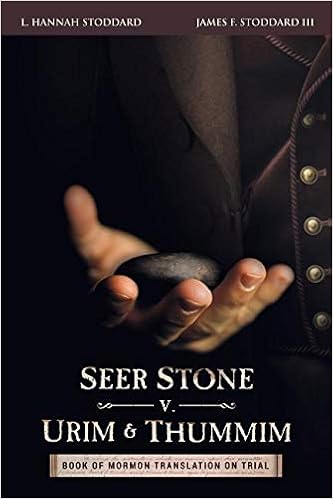
Seer Stone v. Urim and Thummim: Book of Mormon Translation on Trial


I became keenly interested in the translation method of the Book of Mormon after reading the book, Joseph Smith's Seer Stones, by Michael Hubbard Mackay and Nicholas J. Frederick.

This book prompted further purchases and months of research. It also inspired a number of posts here at AF under the LABEL: Book of Mormon-translation method—the first of which was published back on June 29, 2017 (link).

A few months after the first post of the series, I published a thread (link) that raised a number of serious questions concerning the paradigm shift in the understanding of the translation method/process of the Book of Mormon by many Latter-day Saints. Foremost among those questions was the following:

The question that needs to be asked is: WHY has Kirkham's and Nibley's assessments been jettisoned by so many 21st century LDS scholars?

I immediately followed the above question with some reasons provided by LDS scholars who have embraced the paradigm shift—reasons which I am currently of the opinion are somewhat dubious in nature.

Now, up until just a few days ago, I thought I was pretty much the sole 'voice in the wilderness' who had some serious questions concerning this paradigm shift in the understanding of the Book of Mormon translation method. Last week, I finished reading the recently published book, Seer Stone v. Urim and Thummim: Book of Mormon Translation on Trial—I now know that I am not alone.

This book focuses on a number of the extant 'witnesses' of the Book of Mormon translation method/process, including an important, detailed examination of David Whitmer. His chapter, "David Whitmer vs. David Whitmer" (#14), is of particular interest, exposing a number of inconsistencies in the recorded Whitmer statements.

I sincerely hope that folk interested in this topic will purchase the book, and share their reflections on it.

The book can be obtained via Amazon (link), or directly through the publisher (link).


Grace and peace,


David