Showing posts with label A.N.S. Lane. Show all posts

Monday, October 31, 2016

"you will receive no other law for your belief than that interpretation of the Scripture which seems to you the best"


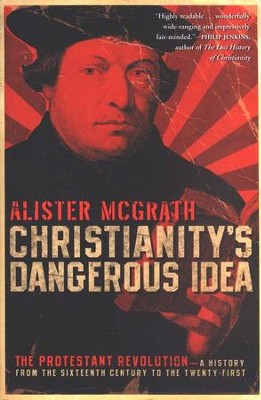
I am going to reserve comment on the quotation from the title of this thread until the end of this post, focusing instead, for now, on Alister McGrath's, Christianity's Dangerous Idea: The Protestant Revolution, which I recently finished reading (link to Google Books preview).

I had actually purchased this book—along with a number of others—a few months back, but did not get around to reading it until just a few days ago. Dr. McGrath is one of my favorite Protestant authors, especially his works on Christian history (both history proper, as well as historical theology), and this book did not disappoint. If one is looking for a polemical treatment on the subject he addresses, don't bother purchasing the book; but, if one is looking for a concise, objective and balanced contribution, definitely get a hold of a copy.

His introduction sets the tone (of course) for the book, beginning with some reflections on the July 1998 Lambeth Conference. From the pen of Dr. McGrath we read:

In July 1998, the bishops of the Anglican Communion met in the historic English cathedral city of Canterbury for their traditional Lambeth Conference, held every ten  years. The intention was to address the many challenges and opportunities that Anglicanism faced worldwide...The bishops gathered every day for prayer and Bible study, a powerful affirmation of the role of the Bible in sustaining Christian unity, guiding the church in turbulent times, and nourishing personal spirituality.

But how was the Bible to be interpreted...

How, many Anglicans wondered, could the Bible be the basis for their identify and unity when there was such obvious disunity on how it was to be understood? How could a text-based movement have a coherent inner identify when there was such a clear and fundamental disagreement on how that text was to be interpreted and applied on an issue of critical importance?

The idea that lay at the heart of the sixteenth-century Reformation, which brought Anglicanism and the other Protestant churches into being, was that the Bible is capable of being understood by all Christian believers—and that they all have the right to interpret it and to insist upon their perspectives being taken seriously. Yet this powerful affirmation of spiritual democracy ended up unleashing forces that threatened to destabilize the church, eventually leading to fissure and formation of breakaway groups...

The dangerous new idea, firmly embodied at the heart of the Protestant revolution, was that all Christians have the right to interpret the Bible for themselves. However, it ultimately proved uncontrollable, spawning developments that few at the time could have envisaged or predicted. (Pages 1, 2)

On the next page, he raises two very important questions:

Who has the authority to define its faith? Who has the right to interpret its fundamental document, the Bible? (Page 3)

This is followed with:

The outbreak of the Peasant's War in 1525 brought home to Luther that his new approach was dangerous and ultimately uncontrollable. If every individual was able to interpret the Bible as he pleased, the outcome could only be anarchy and radical individualism. Too late, Luther tried to rein in the movement by emphasizing the importance of authorized leaders, such as himself, and institutions in the interpretation of the Bible. But who, his critics asked, "authorized" these so-called authorities? (Page 3 - bold emphasis mine.)

The above questions are repeated throughout the book. In addition to strict individualism, the issue of competing "authorities" creating fragmentation almost from the very beginning of the Protestant revolt/revolution are raised. Dr. McGrath states that, "There was no single Wittenberg reforming program, no single approach to biblical interpretation and application" (p. 65).

Is it any wonder that such problems were greatly magnified as the revolt/revolution spread from Wittenberg?

McGrath moves on from Wittenberg to Zurich and Zwingli, then to the Anabaptists; and in chapter 4, to John Calvin. Chapter 5 is devoted to England and the "Emergence of Anglicanism", which is followed by "European Protestantism in Crisis, 1560–1800" (ch. 6), and then "Protestantism in America" (ch. 7).

Questions concerning authority and interpretation continue. Chapter 10, "The Bible and Protestantism" is excellent, containing reflections on the issues of sola scriptura, translations, commentaries, lectionaries, theological works and the canon.

On page 209, he writes:

Since every Protestant has the right to interpret the Bible, a wide range of interpretations cannot be avoided. And since there is no centralized authority within Protestantism, this proliferation of options cannot be controlled. Who has the right to decide what is orthodox and what is heretical?

And just a bit later he states:

Over the years, each strand of Protestantism developed its own way of understanding and implementing the sola Scriptura principle.

Dr. McGrath has added confirmation to many important issues that have been raised here at AF. From almost the beginning of this blog, I have pointed out that the assessments of A.N.S. Lane in his important article, “Scripture, Tradition and Church: An Historical Survey” (LINK), raise some serious, unanswered problems for the Protestant paradigm. The following quotation from Lane's work has been published at the bottom of the right side-bar of this blog for nearly a decade now:

The Reformers unequivocally rejected the teaching authority of the Roman Catholic Church. This left open the question of who should interpret Scripture. The Reformation was not a struggle for the right of private judgement. The Reformers feared private judgement almost as much as did the Catholics and were not slow to attack it in its Anabaptist manifestation. The Reformation principle was not private judgement but the perspicuity of the Scriptures. Scripture was ‘sui ipsius interpres’ and the simple principle of interpreting individual passages by the whole was to lead to unanimity in understanding. This came close to creating anew the infallible church…It was this belief in the clarity of Scripture that made the early disputes between Protestants so fierce. This theory seemed plausible while the majority of Protestants held to Lutheran or Calvinist orthodoxy but the seventeenth century saw the beginning of the erosion of these monopolies. But even in 1530 Casper Schwenckfeld could cynically note that ‘the Papists damn the Lutherans; the Lutherans damn the Zwinglians; the Zwinglians damn the Anabaptists and the Anabaptists damn all others.’ By the end of the seventeenth century many others saw that it was not possible on the basis of Scripture alone to build up a detailed orthodoxy commanding general assent. (A.N.S. Lane, “Scripture, Tradition and Church: An Historical Survey”, Vox Evangelica, Volume IX – 1975, pp. 44, 45 – bold emphasis mine.)

And back in Nov. 2009, I posted the following from yet another Reformed author:

Unlike modern Evangelicalism, the classical Protestant Reformers held to a high view of the Church. When the Reformers confessed extra ecclesiam nulla salus, which means “there is no salvation outside the Church,” they were not referring to the invisible Church of all the elect. Such a statement would be tantamount to saying that outside of salvation there is no salvation. It would be a truism. The Reformers were referring to the visible Church…The Church is the pillar and ground, the interpreter, teacher, and proclaimer of God’s Word…The Church has authority because Christ gave the Church authority. The Christian who rejects the authority of the Church rejects the authority of the One who sent her (Luke 10:16). (Keith A. Mathison, The Shape of Sola Scriptura, pp. 268, 269.)

Clearly, the questions of individual interpretation and authority outside the Bible itself raised by Dr. McGrath are/were also on the minds of Lane and Mathison.

And so, with all this in mind, I shall ask: how does one determine which interpretation of the Bible is the correct one? And further, is there an authority in place which/who has the approval from God himself to provide the correct interpretation of His Word?

Now, back to the opening quotation/title of this thread:

"you will receive no other law for your belief than that interpretation of the Scripture which seems to you the best"

This quotation is from Francis de Sales, The Catholic Controversy (page 3, of Mackey's English trans., third edition, 1909 - PDF version available online HERE).

For anyone who has ever pondered over the questions raised by Dr. McGrath, I sincerely believe that you owe it to yourself to read de Sales thoughtful answers.


Grace and peace,

David 

Thursday, August 4, 2011

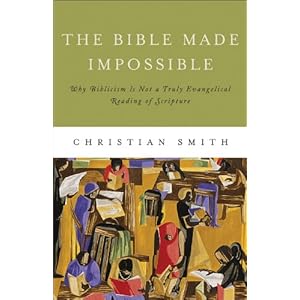
New book of interest: The Bible Made Impossible


It is extremely rare for me to recommend a book that I have yet to read, but I am going to venture into such rarity, concerning the above book (link to purchasing options). I have done so, based on the following three online reviews:


Dr. Peter Enns – “Have Evangelicals Made the Bible Impossible?

Dr. Tim Henderson – “Christian Smith: The Crumbling Foundation of Biblicism (Part 1)”

Kevin DeYoung – “Christian Smith Makes the Bible Impossible”


The first two reviews are favorable, whilst the third is hostile. Having not yet read the book myself, I am unable at this time to assess the reviews; however, I did find the following from Dr. Enns review to be cogent:

Smith’s central contention is that “pervasive interpretive pluralism” renders moot evangelical presumptions of the nature and authority of Scripture.

The above seems to duplicate the insightful reflections of Dr. A.N.S. Lane on this subject. I have provided the following from his pen on the right side-bar of this blog for over three years now:

It was this belief in the clarity of Scripture that made the early disputes between Protestants so fierce. This theory seemed plausible while the majority of Protestants held to Lutheran or Calvinist orthodoxy but the seventeenth century saw the beginning of the erosion of these monopolies. But even in 1530 Casper Schwenckfeld could cynically note that ‘the Papists damn the Lutherans; the Lutherans damn the Zwinglians; the Zwinglians damn the Anabaptists and the Anabaptists damn all others.’ By the end of the seventeenth century many others saw that it was not possible on the basis of Scripture alone to build up a detailed orthodoxy commanding general assent. (A.N.S. Lane, “Scripture, Tradition and Church: An Historical Survey”, Vox Evangelica, Volume IX – 1975, pp. 44, 45 – bold emphasis mine - LINK)


I have ordered this book, and hope to post some further reflections once I have read it (the Lord willing).


Grace and peace,

David

Thursday, February 17, 2011

The secretive "TurretinFan" continues his censorship tactics


Against what may have been my better judgment (based on previous combox encounters with the secretive, paranoid, gent who goes by the name "TurretinFan"), I decided to respond to the following post penned by the anti-Catholic, Reformed "pastor", David King, in the combox of the Februray 15, 2001 thread at the Thoughts of Fancis Turretin blog:

...yet not demonstrate how the early Church was "Protestant" in the way Mathison suggests.

I am going to address this one point because it is such an utter distortion of what Dr. Mathison has actually said and argued. I hope that maybe our Romanist poster will actually get this, though I doubt he is capable of it.

Protestants do not argue that the early church was Protestant, and Dr. Mathison never argued that. What he has argued (and convincingly so) is that the ancient church was not a bunch of Romanists, and that the ancient church certainly didn't hold to the modern day dogmas of papal primacy or papal infallibility. Now, I understand that this goes right over the head of the average wanna-be Roman apologist, but we have to keep saying it whether they ever understand it or not. The early church was catholic, not a bunch of Romanists as Romanists contend. Now I understand that Romanists want to be called "catholics," but that is simply wishful thinking. The church of Rome has departed from the catholic faith, especially so having dogmatized so many "articles of faith" that are uncatholic, ahistorical, and unbiblical. It's a pretty convenient contention to assert, "one must be in communion with the bishop of Rome" in order to be "catholic." But that is not the spirit of catholicism. It is the spirit of Diotrephes "who loves to have the preeminence" ( 3 John 9). That is what Dr. Mathison has argued. Now, we understand you can't see it, but we are always happy to restate it for you over and over. :) (Wednesday, February 16, 2011 6:00:00 PM )

The above post is so typical of David King's caustic, polemical, ad hominem style; I responded with:

>>Protestants do not argue that the early church was Protestant, and Dr. Mathison never argued that. What he has argued (and convincingly so) is that the ancient church was not a bunch of Romanists, and that the ancient church certainly didn't hold to the modern day dogmas of papal primacy or papal infallibility.>>

Me: But it has certainly become vogue among a number of anti-Roman Catholic apologists to argue that certain Protestant doctrines were held by the "early church" (contra a consensus of prominent Protestant patristic scholars).

>>Now, I understand that this goes right over the head of the average wanna-be Roman apologist, but we have to keep saying it whether they ever understand it or not. The early church was catholic, not a bunch of Romanists as Romanists contend.>>

Me: Perhaps some "Romanists", but certainly not all Roman Catholic patristic scholars; fact is, a good number of Roman Catholic patristic scholars acknowledge doctrinal development.

>>Now I understand that Romanists want to be called "catholics," but that is simply wishful thinking.>>

Me: ROFL

>>The church of Rome has departed from the catholic faith, especially so having dogmatized so many "articles of faith" that are uncatholic, ahistorical, and unbiblical.>>

Me: Are you a Socinian? (hyperbole); I know that you are not, but you do argue like one (historically speaking).

Grace and peace,

David (Thursday, February 17, 2011 7:04:00 AM )

[Note: See these 3 threads for important material on why found King’s statement about the RCC not being “catholic” humorous; and this thread for supportive data concerning my Socinian comment.]

David King then posted:

Me: Are you a Socinian? (hyperbole); I know that you are not, but you do argue like one (historically speaking).

Let's see, Mr. Waltz, you profess to have been a Jehovah's Witness, an evangelical, a member of the Roman communion which you said you left some months back, and now who knows what you profess to be. And you want to ask me about being a Socinian? Apparently you don't realize that's a glass house you've built for yourself - be careful with those rocks. :) (Thursday, February 17, 2011 2:09:00 PM )

And in response to one of "TurretinFan's" ill-conceived comments, I wrote:

>>Whether or not the method of argumentation with respect to history is similar doesn't turn this into a valid criticism. After all, the Socinians were not rejected on account of their method of argument but on account of their false doctrines.>>

It painfully obvious that you have not read the arguments that were put forth in the 16th century to curtail the Socinian threat, for one of the primary 'weapons' employed was an attack on their "method of argument". (Thursday, February 17, 2011 10:20:00 PM )


Now, the above are the posts that have remained undeleted by "TurretinFan". The following are my posts that were deleted:

1.) >>Let's see, Mr. Waltz, you profess to have been a Jehovah's Witness, an evangelical, a member of the Roman communion which you said you left some months back, and now who knows what you profess to be. And you want to ask me about being a Socinian? Apparently you don't realize that's a glass house you've built for yourself - be careful with those rocks. :)>>

Interesting comments for sure! Let's see, perhaps you would have me to have remained a JW (the faith God providentially ordained that I was to be born into); or perhaps you would have me to have remained Reformed (not strictly evangelical) after learning of the scandalous schisms that plagued (and continue to plague) the English speaking Reformed paradigm; or perhaps you would have me to have remained Roman Catholic, after years of in depth study lead me to the conclusion that I could no longer affirm an infallible magisterium; or perhaps you would have me to start my own church, as did the co-author/publisher (engineer by trade) of the 3 volume work you helped to produce...hmmm...yes, very interesting...


2.) >>I'm not going to comment on the allegation of contradicting a consensus of "prominent Protestant patristic scholars.">>

A wise choice, for my statement was NOT a mere "allegation", but rather, a fact.

The fathers of the church spoke as they did because they regarded themselves as interpreters of the Scriptures. Therefore they are not to be made a substitute for the Scriptures; nor can the Scriptures be understood apart from the authoritative interpretation which tradition places upon them...if tradition is primitive, Protestant theology must admit that ‘Scripture alone’ requires redefinition. (Jaroslav Pelikan, Obedient Rebels, Harper & Row: New York, N. Y., 1964, p. 180 – bold emphasis mine.)


The divine Scriptures of the Old and New Testaments, as opposed to human writings; and the oral tradition or living faith of the catholic church from the apostles down, as opposed tothe varying opinions of heretical sects—together form one infallible source and rule of faith. Both are vehicles of the same substance: the saving revelation of God in Christ; with this difference in form and office, that the church tradition determines the canon, furnishes the key and true interpretation of the Scriptures, and guards them against heretical abuse. (Philip Schaff, History of the Christian Church, Eerdmans: Grand Rapids, MI, 1981 ed., vol. 3, p. 606 – bold emphasis mine.)

Several publications by evangelicals have argued that the doctrine of sola scriptura was practiced, though implicitly, in the hermeneutical thinking of the early church. Such an argument is using a very specific agenda for the reappropriation of the early church: reading the ancient Fathers through the leans of post-Reformational Protestantism…Scripture can never stand completely independent of the ancient consensus of the church’s teaching without serious hermeneutical difficulties…the real question, as the patristic age discovered, is, Which tradition will we use to interpret the Bible? (D. H. Williams, Retrieving the Tradition & Renewing Evangelicalism, pp. 229, 234 – bold emphasis mine.)

Perhaps the most important aspect of the rule of faith is that it gives us what the Church conceived to be ‘the main body of truth’ (to use Irenaeus’ phrase). The Scriptures are, after all, a body of documents testifying to God’s activity towards men in Christ. They are not a rule of faith, nor a list of doctrines, nor a manual of the articles of a Christian man’s belief. In the rule of faith we have a key to what the Church thought the Scriptures came to, where it was, so to speak, that their weight fell, what was their drift. This interpretation of their drift was itself tradition, a way of handling the Scriptures, a way of living in them and being exposed to their effect, which, while not an original part of the Christian Gospel, not itself the paradosis par excellence, had been developed from the Gospel itself, from its heart, under the guidance of the Holy Spirit as an essential part of the existence of the Christian faith in history…We cannot recognize the rule of faith as original tradition, going back by oral continuity independently of Scripture to Christ and his apostles. But we can recognize it as the tradition in which the Church was interpreting Scripture under the guidance of the Holy Spirit, and as such claim it as an essential ingredient of historical Christianity. (R.P.C. Hanson, Tradition In The Early Church, pp. 128, 129 – bold emphasis mine.)

The first clear attitude to emerge on the relation between Scripture, tradition and the church was the coincidence view: that the teaching of the church, Scripture and tradition coincide. Apostolic tradition is authoritative but does not differ in content from the Scriptures. The teaching of the church is likewise authoritative but is only the proclamation of the apostolic message found in Scripture and tradition. The classical embodiment of the coincidence view is found in the writings of Irenaeus and Tertullian.

These both reject the Gnostic claims to a secret tradition supplementing Scripture. Apostolic tradition does not add to Scripture but is evidence of how it is correctly to be interpreted. This tradition is found in those churches which were founded by the apostles, who taught men whose successors teach today. These apostolic churches agree as to the content of the Christian message, in marked contrast to the variations among the heretics. It is important to note that it is the church which is the custodian of Scripture and tradition and which has the authentic apostolic message. There was no question of appealing to Scripture or tradition against the church. This is partly because the apostolic tradition was found in the church but not just for this reason: the Holy Spirit preserves the church from error and leads her into the truth. The real concern of Irenaeus and Tertullian was not with the relation between Scripture and tradition but with the identity of ecclesiastical with apostolic teaching. Any exposition of their teaching on Scripture and tradition which fails to show this is to that extent defective. (A.N.S. Lane, “Scripture, Tradition and Church: An Historical Survey”, Vox Evangelica, Volume IX – 1975, pp. 39, 40 – bold emphasis mine.)

The ‘ancillary view’ is Lane’s term for the sixteenth-century Protestant view, in which tradition functions as an aid, but not a norm, for the interpretation of Scripture…In spite of claims to the contrary, the Reformers did not return to the ‘coincidence view’…The Reformation posited a degree of discontinuity in church history… (Richard Bauckham, “Tradition In Relation To Scripture and Reason”, in Scripture, Tradition, and Reason, ed. Drewery & Bauckham, p. 122.)

As I said earlier, I had some reservations about commenting on "TurretinFan's" blog, fearing that he would delete posts that he perceives to be 'damaging' to his anti-Catholic cause. Maybe I should have listened to my inner voice; but then, if I had said nothing, the 'silliness' would have gone unchallenged...


Grace and peace,

David

Saturday, November 7, 2009

Scripture and Tradition: the early Church Fathers and patristic scholarly consensus vs. TurretinFan


Earlier today, TurretinFan (hereafter TF) published the 11th installment of his anti-Catholic polemical series Perspicuity of Scripture Contra Bellisario. TF, in essence, sums up his view of the early Church Fathers concerning Scripture and Tradition with:

Unfortunately, Mr. Bellisario does not understand that the quotation defeats his position, not mine. We appeal to tradition just as Irenaeus did. We don't do it because tradition is a separate source of infallible authority, but because folks like the Gnostics and Roman Catholics think that it is. We show that they hold neither to Scripture nor Tradition, preferring their own inventions to both.

Mr. Bellisario would like to read into Irenaeus a modern Roman Catholic view of tradition, but Irenaeus himself doesn't say what Rome says. Irenaeus does not claim that tradition is necessary in order to understand Scripture: he ascribes that error to the Gnostics. Irenaeus acknowledges (as we do) the reality of tradition, but does not make it infallible, as Mr. Bellisario would wish. (Accessed online 11-07-09.)

“Unfortunately”, TF, yet once again, has misread a Church Father. Note the following:

There was, however, another aid which he looked upon as of the most certain and most important utility, so far as it extended, and that was the baptismal creed, which he regarded as infallible for leading to the right sense of Scripture upon fundamental points, and according to which he thought all Scripture ought to be interpreted. [I.ix.4] It is evident, therefore, that he regarded the tradition of the Church, to that extent, as divine and infallible. (James Beaven, An Account of the Life and Writings of S. Irenaeus, Bishop of Lyons and Martyr, 1841, p. 139 – bold emphasis mine.)

For the record, James Beaven was not a Roman Catholic (I have added “Roman” to Catholic for TF), but TF is most certainly an anti-Catholic; with this in mind, whose assessment of Irenaeus would one discern to be the least polemical, and most objective?

Moving on, I would now like to comment on the issue of the perspicuity of Scripture as a whole. With TF, I too believe in the perspicuity of Scripture—Scripture clearly teaches baptismal regeneration, infant baptism, the real presence of Christ in the Eucharist, apostolic succession, et al.—you see, my position on this issue is fundamentally the same as Irenaeus, Athanasius, and so many other Church Fathers. Yes, Scripture is CLEAR, but only to those who embrace the Catholic regula fidei. Everyone has, in essence, a regula fidei which governs their interpretation of Scripture—the Arians created a regula fidei, the Socinians created a regula fidei, the Lutherans created a regula fidei, the Calvinists created a regula fidei—yes, everyone has a regula fidei, and for some, it is a regula fidei created, and held to, by but one individual.

Though many do to not realize it, the regula fidei that one embraces is inextricably linked to church authority. One Reformed author recently articulated this very important connection:

Unlike modern Evangelicalism, the classical Protestant Reformers held to a high view of the Church. When the Reformers confessed extra ecclesiam nulla salus, which means “there is no salvation outside the Church,” they were not referring to the invisible Church of all the elect. Such a statement would be tantamount to saying that outside of salvation there is no salvation. It would be a truism. The Reformers were referring to the visible Church…The Church is the pillar and ground, the interpreter, teacher, and proclaimer of God’s Word…The Church has authority because Christ gave the Church authority. The Christian who rejects the authority of the Church rejects the authority of the One who sent her (Luke 10:16). (Keith A. Mathison, The Shape of Sola Scriptura, pp. 268, 269.)

Now admittedly, for some, their “church authority” is themselves, but I think most would agree that Mathison had in mind ‘confessional’ churches. Mathison maintains that “the Church” has real authority, while at the same time holding to the perspicuity of Scripture; he believes, as do I (and the early Church Fathers), that the two are not mutually exclusive. Mathison’s view was cogently expressed by none other than John Henry Newman back in the 19th century—note the following, which Newman addressed to his Anglican friend Dr. E. B. Pusey:

You have made a collection of passages from the Fathers, as witnesses in behalf of your doctrine that the whole Christian faith is contained in Scripture, as if, in your sense of the words, Catholics contradicted you here. And you refer to my Notes on St. Athanasius as contributing passages to your list; But, after all, neither you, nor I in my Notes, affirm any doctrine which Rome denies. Those Notes also make frequent reference to a traditional teaching, which (be the faith ever so contained in Scripture), still is necessary as a Regula Fidei, for showing us that it is contained there; vid. Pp. 283-431; and this tradition, I know, you uphold as fully as I do in the Notes in question. In consequence, you allow that there is a two-fold rule, Scripture and Tradition; and this is all that Catholics say. How, then do Anglicans differ from Rome here? I believe the difference is merely one of words… (John Henry Newman, Certain Difficulties Felt By Anglicans In Catholic Teaching Considered, vol. 2, pp. 11, 12.)

Once again, Scripture is CLEAR, but only for those who have embraced the true regula fidei. This was THE view of the majority of the early Church Fathers, and has been recognized as such by a consensus of patristic scholars; the following are but a few selections from this overwhelming consensus:

The fathers of the church spoke as they did because they regarded themselves as interpreters of the Scriptures. Therefore they are not to be made a substitute for the Scriptures; nor can the Scriptures be understood apart from the authoritative interpretation which tradition places upon them...if tradition is primitive, Protestant theology must admit that ‘Scripture alone’ requires redefinition. (Jaroslav Pelikan, Obedient Rebels, Harper & Row: New York, N. Y., 1964, p. 180 – bold emphasis mine.)

The divine Scriptures of the Old and New Testaments, as opposed to human writings; and the oral tradition or living faith of the catholic church from the apostles down, as opposed tothe varying opinions of heretical sects—together form one infallible source and rule of faith. Both are vehicles of the same substance: the saving revelation of God in Christ; with this difference in form and office, that the church tradition determines the canon, furnishes the key and true interpretation of the Scriptures, and guards them against heretical abuse. (Philip Schaff, History of the Christian Church, Eerdmans: Grand Rapids, MI, 1981 ed., vol. 3, p. 606 – bold emphasis mine.)

Several publications by evangelicals have argued that the doctrine of sola scriptura was practiced, though implicitly, in the hermeneutical thinking of the early church. Such an argument is using a very specific agenda for the reappropriation of the early church: reading the ancient Fathers through the leans of post-Reformational Protestantism…Scripture can never stand completely independent of the ancient consensus of the church’s teaching without serious hermeneutical difficulties…the real question, as the patristic age discovered, is, Which tradition will we use to interpret the Bible? (D. H. Williams, Retrieving the Tradition & Renewing Evangelicalism, pp. 229, 234 – bold emphasis mine.)

Perhaps the most important aspect of the rule of faith is that it gives us what the Church conceived to be ‘the main body of truth’ (to use Irenaeus’ phrase). The Scriptures are, after all, a body of documents testifying to God’s activity towards men in Christ. They are not a rule of faith, nor a list of doctrines, nor a manual of the articles of a Christian man’s belief. In the rule of faith we have a key to what the Church thought the Scriptures came to, where it was, so to speak, that their weight fell, what was their drift. This interpretation of their drift was itself tradition, a way of handling the Scriptures, a way of living in them and being exposed to their effect, which, while not an original part of the Christian Gospel, not itself the paradosis par excellence, had been developed from the Gospel itself, from its heart, under the guidance of the Holy Spirit as an essential part of the existence of the Christian faith in history…

We cannot recognize the rule of faith as original tradition, going back by oral continuity independently of Scripture to Christ and his apostles. But we can recognize it as the tradition in which the Church was interpreting Scripture under the guidance of the Holy Spirit, and as such claim it as an essential ingredient of historical Christianity. (R.P.C. Hanson, Tradition In The Early Church, pp. 128, 129 – bold emphasis mine.)

The first clear attitude to emerge on the relation between Scripture, tradition and the church was the coincidence view: that the teaching of the church, Scripture and tradition coincide. Apostolic tradition is authoritative but does not differ in content from the Scriptures. The teaching of the church is likewise authoritative but is only the proclamation of the apostolic message found in Scripture and tradition. The classical embodiment of the coincidence view is found in the writings of Irenaeus and Tertullian.

These both reject the Gnostic claims to a secret tradition supplementing Scripture. Apostolic tradition does not add to Scripture but is evidence of how it is correctly to be interpreted. This tradition is found in those churches which were founded by the apostles, who taught men whose successors teach today. These apostolic churches agree as to the content of the Christian message, in marked contrast to the variations among the heretics. It is important to note that it is the church which is the custodian of Scripture and tradition and which has the authentic apostolic message. There was no question of appealing to Scripture or tradition against the church. This is partly because the apostolic tradition was found in the church but not just for this reason: the Holy Spirit preserves the church from error and leads her into the truth. The real concern of Irenaeus and Tertullian was not with the relation between Scripture and tradition but with the identity of ecclesiastical with apostolic teaching. Any exposition of their teaching on Scripture and tradition which fails to show this is to that extent defective. (A.N.S. Lane, “Scripture, Tradition and Church: An Historical Survey”, Vox Evangelica, Volume IX – 1975, pp. 39, 40 – bold emphasis mine.)

The ‘ancillary view’ is Lane’s term for the sixteenth-century Protestant view, in which tradition functions as an aid, but not a norm, for the interpretation of Scripture…In spite of claims to the contrary, the Reformers did not return to the ‘coincidence view’…The Reformation posited a degree of discontinuity in church history… (Richard Bauckham, “Tradition In Relation To Scripture and Reason”, in Scripture, Tradition, and Reason, ed. Drewery & Bauckham, p. 122.)


So, TF’s read of the early Church Fathers, or that represented by the above patristic scholars; TF’s regula fidei, or that of the Catholic Church? IMO, the answer to both questions is perspicuous.


Grace and peace,

David

Monday, June 22, 2009

Scripture and Tradition in the early Church Fathers


Certain comments made in the last post (#37) of the PREVIOUS THREAD have prompted me to explore in a bit more depth the relationship between Scripture and Tradition in the writings of early Church Fathers. Those who have read the initial post and subsequent comments of the previous thread should now be cognizant of the reflections of at least two prominent Protestant scholars (A.N.S. Lane and D. H. Williams) who subscribe to the position that the ECFs held to the “coincidence view” of Scripture and Tradition—i.e. that Scripture and Tradition do not differ in content, and that both are equally authoritative. This position differs from the magisterial Reformers’ take (Luther, Zwingli, Calvin, et al.) which is labeled the “ancillary view”. Lane articulates the differences between the two positions:

The essence of the coincidence view is the assumption not just that Scripture and tradition have the same content but also that this content is found in the teaching of the church. The error in attributing the coincidence view to the Reformers lies in the neglect of their ecclesiology. They did allow for an interpretative tradition not adding to Scripture but did not see either this tradition or ecclesiastical teaching as infallible…The Reformers’ attitude to tradition was neither the coincidence nor the supplementary view but the ancillary view. They viewed tradition not as a normative interpretation of Scripture nor as a necessary supplement to it but rather as a tool to be used to help the church to understand it. (A.N.S. Lane, “Scripture, Tradition and Church: An Historical Survey”, Vox Evangelica, Volume IX – 1975, p. 43.)

Herein lies (IMHO), the most important distinctions between the coincidence and ancillary views—though each of the two allow for “interpretive tradition”, the latter position denies that this tradition both is “normative” and “infallible”.

Now, I do not believe that the current understanding of Scripture and Tradition by many important Catholic scholars is identical with the ECFs (for as with all doctrines, there have been important developments), but I do believe that the current Catholic position is much closer to the ECFs than most (all?) Protestant views.


Grace and peace,

David

Thursday, July 24, 2008

On Private Judgment


As comments, and interest, in my series on doctrinal development appeared to be nearing an end, I thought I would devote a bit of my non-committed time to other goings on in the blog world. A thread at the Beggar’s All blog caught my eye (HERE) and I decided to respond. As with many threads at BA, the combox took on a life of its own, moving away from “faith alone” into other controversial genre, one of which was the issue concerning “private judgment”; it seems that I am the ‘guilty’ party, for it was my quote of A.N.S. Lane’s essay (see side bar) which referenced the following: “The Reformers feared private judgement almost as much as did the Catholics and were not slow to attack it in its Anabaptist manifestation.” This prompted a response by Jason Loh, who posts under the name of ‘Augustinian Successor’. Jason wrote:

Well, Lane's thesis is refuted by McGrath in "Christianity's Dangerous Idea: The Protestant Revolution, a history from the sixteenth century to the twenty-first".

Lane is mistaken here. The RIGHT to private judgment was one of the principles of Reformation. The issue relates to USE of private judgment: is it based on sola Scriptura? If so, how is sola Scriptura understood?

Sola Scriptura does not mean abandonment of Tradition but re-defining its use to ensure and maintain continuity. Sola Scriptura does not mean ecclesial and liturgical arrangements for the sake of good order (not by divine institution, unlike Romanism in reference to e.g. the papacy - therein lies the difference) can be opposed with impunity.
And again:

Of course Lane was mistaken. He confused the RIGHT to private judgment with the USE of private judgment. The ABUSE of private judgment could be seen in Luther's confrontation with the Schwaermer (Enthusiasts).

The LIMITS to private jugdment is set out in e.g. Article XXXIV - Of the TRADITIONS of the CHURCH:


"It is not necessary that Traditions and Ceremonies be in all places one, and utterly like; for at all times they have been divers, and may be changed according to the diversities of countries, times, and men's manners, so that nothing be ordained against God's Word. Whosoever through his private judgement, willingly and purposely, doth openly break the traditions and ceremonies of the Church, which be not repugnant to the Word of God, and be ordained and approved by common authority, ought to be rebuked openly, (that others may fear to do the like,) as he that offendeth against the common order of the Church, and hurteth the authority of the Magistrate, and woundeth the consciences of the weak brethren.Every particular or national Church hath authority to ordain, change, and abolish, ceremonies or rites of the Church ordained only by man's authority, so that all things be done to edifying."

Jason’s response reveals two important details concerning “private judgment”: first, there are “LIMITS”; and second, these “LIMITS” involve the issue of Church authority.

I then responded with:

Lane is not saying that Luther, Calvin, Knox, et al. denied “the RIGHT to private judgment” IN A CERTAIN SENSE. As a Catholic, I too have “the RIGHT to private judgment” within a set of historically defined parameters (e.g. Ecumenical Councils and ex cathedra promulgations). What Lane IS saying is that in PRACTICE, there was little difference between Calvin’s “Church” and Sadolet’s “Church”. Though Calvin denied infallibility to creeds, confessions, catechisms et al., they in day-to-day church polity functioned as such.

I sincerely thought that Jason would come to the understanding that Dr. Lane was not “mistaken”, that he was actually affirming what Jason had earlier said with different terminology and emphasis. But I was wrong—Jason then posted:

"The Reformers feared private judgement almost as much as did the Catholics and were not slow to attack it in its Anabaptist manifestation."

David, as the above quotation shows you've thoroughly misread Lane, and Lane was mistaken (as he tried to equate the Reformers' fear of private judgment with the Roman), and you're absolutely wrong. Let me spell this out to you, AGAIN, since you're not listening to me.

The right to private judgment is one of the principles of the Reformation. It is grounded in the priesthood of all believers. The Roman Church denies the latter theological premise and hence private judgment. Private judgment is a dirty word in the Magisterium, remember?

Once again, Dr. Lane is not denying “private judgment”, he is merely affirming that the Reformers placed “LIMITS” on it—greater “LIMITS” than Jason seems to realize. And perhaps even more importantly, Jason seems to think that Catholics deny “private judgment”, when in fact, “private judgment” (with, of course, “LIMITS”) is affirmed. Note what the famous English Catholic convert, Ronald Knox wrote on this issue:

By an equally grotesque illusion, most Englishmen have the idea that Catholics base all their religious beliefs on the authority of the Church…Let me then avoid further ambiguity, give a list of certain leading doctrines which no Catholic, upon a moment’s reflection, could accept on the authority of the Church and on that ground alone.

1. The existence of God.

2. The fact that he has made a revelation to the world in Jesus Christ.

3. The Life (in its broad outlines), the Death, and the Resurrection of Jesus Christ.

4. The fact that our Lord founded a Church.

5. The fact that he bequeathed to that Church his own teaching office, with the guarantee (naturally) that it should not err in teaching.

6. The consequent intellectual duty of believing what the Church believes.
(Ronald Knox, The Belief of Catholics, pp. 30, 31.)

He follows this with:

“When you have contrived to persuade him that, for Catholics, the authority of the Church in matters of faith is not a self-evident axiom, but a truth arrived at by a process of argument, the Protestant controversialist has his retort ready. ‘You admit, then after all,’ he says, ‘that a man has to use his own private judgment in order to arrive at religious truth? Why, then, what is the use of authority in religion at all? I had always supposed that there was a straight issue between us, you supporting authority and I private judgment; I had always supposed that you criticised me for my presumption in searching for God by the light of my imperfect human reason; it proves, now that you are no less guilty of such presumption than myself! Surely your reproaches are inconsistent, and your distinctions unnecessary. If you use your private judgment to establish certain cardinal points of theology, the existence of God, the authority of Christ, and so on, why may I not use my private judgment to establish not only these, but all other points of theology…” (Ibid., pp. 34, 35.)

To which Knox replies:

“I could not have imagined, if I had not heard it with my own ears, the accent of surprise with which Protestants suddenly light upon this startling discovery, that the belief we Catholics have in authority is based upon an act of private judgment. How on earth could they ever suppose we taught otherwise? I say nothing here of the grace of faith, which is the hidden work of God in our souls. But how could the conscious process by which we arrive at any form of truth begin without an act of private judgment?” (Ibid., p. 35.)

And again:

“Reject private judgment? Of course Catholics have never rejected private judgment; they only profess to delimit the spheres in which private judgment and authority have their respective parts.” (Ibid., 35 – bold emphasis mine.)

So, one can clearly see that Catholics affirm “private judgment”, placing “LIMITS” on its use, as does the Thirty-Nine Articles of the Anglicans cited by Jason; as does the Formula of Concord of the Lutherans, from which we read:

With reference to the schism in matters of faith which has occurred in our times, we regard, as the unanimous consensus and exposition of our Christian faith, particularly against the false worship, idolatry, and superstition of the papacy and against other sects, and as the symbol of our time, the first and unaltered Augsburg Confession, which was delivered to Emperor Charles V at Augsburg during the great Diet in the year 1530, together with the Apology thereof and the Articles drafted at Smalcald in the year 1537, which the leading theologians approved by their subscription at that time.

Since these matters also concern the laity and the salvation of their souls, we subscribe Dr. Luther’s Small and Large Catechisms as both of them are contained in his printed works. They are “the layman’s Bible” and contain everything which Holy Scripture discusses at greater length and which a Christian must know for his salvation.

All doctrines should conform to the standards set forth above. Whatever is contrary to them should be rejected and condemned as opposed to the unanimous declaration of our faith.
(Formula of Concord, “The Epitome”, in The Book of Concord, trans. Tappert, p. 465.)

And:

Herewith we again whole-heartedly subscribe this Christian and thoroughly scriptural Augsburg Confession, and we abide by the plain, clear, and pure meaning of its words. We consider this Confession a genuinely Christian symbol which all true Christians ought to accept next to the Word of God, just as in ancient times Christian symbols and confessions were formulated in the church of God when great controversies broke out, and orthodox teachers and hearers pledged themselves to these symbols with heart and mouth. Similarly we are determined by the grace of the Almighty to abide until our end by this repeatedly cited Christian Confession as it was delivered to Emperor Charles in 1530. And we do not intend, either in this or in subsequent doctrinal statements, to depart from the aforementioned Confession or to set up a different and new confession. (Formula of Concord, “Solid Declaration”, in The Book of Concord, trans. Tappert, p. 502.)

And so with The Genevan Confession:

The Confession of Faith which all the citizens and inhabitants of Geneva and the subjects of the country must promise to keep and hold. (1536) (Calvin: Theological Treatises, ed. J.K.S. Reid, p. 26.)

So much for my musings on “private judgment”; I sincerely hope I have shed some important light on this issue.

Grace and peace,

David

Tuesday, May 27, 2008

The 05/22/08 Dividing Line webcast - part 2.


I had little time over the extended Memorial Day weekend to spend on internet related issues, so I had to wait until this morning for the second installment of my treatment of the 05/22/08 The Dividing Line webcast. In the first installment, I dealt with the charges that James had leveled against D.H. Williams’ comments concerning Athanasius and Liberius; in this second thread, I shall address James’ basic contention concerning Athansius’ use of tradition. Rather than typing up excerpts from the webcast, I shall instead refer directly to James’ own essay (“Sola Scriptura and the Early Church”, in Sola Scriptura! - 1995) which formed the basis for James’ argumentation.

In his essay, James argues that: “Sola scriptura has long been the rule of believing Christian people, even before it became necessary to use the specific terminology against later innovators who would usurp the Scriptures supremacy in the church.” (Page 53.)

Here James is making the claim that early Church Fathers (such as Irenaeus, Augustine and Athanasius) believed in, and taught the doctrine of sola scriptura. This by default means that according to James’ assessment, the above mentioned Church Fathers believed and taught that: 1.) the Scriptures are the only infallible rule of faith; 2.) the Scriptures are not only materially sufficient, but also formally sufficient (i.e. the doctrine of perspicuity); 3.) the doctrine many of the early Church Fathers on the relationship between Scripture and tradition was essentially the same as the Reformers doctrine.

But is this the case? In five previous threads on this blog (HERE) I have touched on various aspects concerning the doctrine of sola scriptura. Also, since the inception of the this blog I have provided an excerpt (on the right-hand sidebar), from one of the most important essays on Scripture and tradition ever penned—A.N.S. Lane’s “Scripture, Tradition and Church: An Historical Survey” (for the entire essay GO HERE). All of this material suggests otherwise. But, there is much more, so in a sincere hope to put to rest the view that sola scriptura was taught by many of the early Church Fathers, I shall now provide even more evidence.

Lane’s essay forcefully argues for the position that he has termed “the coincidence view” as representative of the early Church. In other words, “Scripture and tradition coincide”; “Apostolic tradition is authoritative but does not differ from in content from the Scriputres”; the “teaching of the church is likewise authoritative but is only the proclamation of the apostolic message found in Scripture and tradition”; “the Holy Spirit preserves the church from error and leads her into the truth” (page 39). And further: “Scripture is materially sufficient (it contains all that is necessary) but formally insufficient (it needs an intpereter)”; “Tradition is necessary because heretics from Novation to Nestorius have misinterpreted Scripture”; but, “while tradition is the test to be applied to novelty which arises in the church and claims to be scriptural it should not be imagined that this test can be used to question the authoritative decisions of the church” (page 40).

One can immediately discern that Lane does not believe that the early Church maintained a belief in sola scritpura, for formal sufficiency (one of the necessary ingredients of the ‘traditional’ Protestant view) was denied.

And Lane is not only scholar who espouses this view. I have already invoked Dr. Williams, here are a few more examples:

In the ante-Nicene Church, the notion of sola Scriptura does not exist. But then there is also no notion of a tradition which is superior to Scripture, or which alters the essential content of the apostolic message as it is deposited in Scripture. There is simply no way of imagining possible conflict between the Christian Scripture and the Christian tradition—and, therefore, no necessity to choose between them.” (Albert Outler, “The Sense of Tradition in the Ante-Nicene Church”, in The Heritage of Christian Thought: Essays in Honor of Robert Lowery Calhoun, edited by Cushman and Grislis: New York, N. Y., 1965, p.29)

The fathers of the church spoke as they did because they regarded themselves as interpreters of the Scriptures. Therefore they are not to be made a substitute for the Scriptures; nor can the Scriptures be understood apart from the authoritative interpretation which tradition places upon them...if tradition is primitive, Protestant theology must admit that ‘Scripture alone’ requires redefinition.” (Jaroslav Pelikan, Obedient Rebels, Harper & Row: New York, N. Y., 1964, p. 180.)

“Along with total commitment to the Scriptures as the norm of all doctrine, a new and clear conviction concerning the authority of oral tradition began to develop. This oral tradition, handed down from generation to generation and going back through the apostles directly to Christ, in no way conflicted with the Scriptures. But it did aid the church in interpreting the Scriptures and particularly in summarizing the Christian faith and thus protecting Christians against the aberrations of Gnostics and heretics. To Tertullian and Irenaeus, who developed this position, such apostolic tradition, which faithfully transmitted Christ’s teaching, was, like Scripture, infallible.” (Robert D. Preus, “The View of the Bible Held by the Church: The Early Church Through Luther”, in Inerrancy, edited by Norman Geisler, Zondervan: Grand Rapids, MI, 1980, p. 359)

The divine Scriptures of the Old and New Testaments, as opposed to human writings; and the oral tradition or living faith of the catholic church from the apostles down, as opposed tothe varying opinions of heretical sects—together form one infallible source and rule of faith. Both are vehicles of the same substance: the saving revelation of God in Christ; with this difference in form and office, that the church tradition determines the canon, furnishes the key and true interpretation of the Scriptures, and guards them against heretical abuse.” (Philip Schaff, History of the Christian Church, Eerdmans: Grand Rapids, MI, 1981 ed., vol. 3, p. 606)

What was new here? Not the idea that the Bible, being God-given, speaks with God’s authority—that was common ground to both the Reformers and their opponents, and was indeed at that time an unquestioned Christian commonplace, like the doctrine of the Trinity. Nor was there anything new in the Reformer’s insistence that Bible reading is a sweet nourishing activity for Christian people. What was new was the belief, borne upon the Reformer’s by their own experience of Bible study, that Scripture can and does interpret itself to the faithful from within...From the second century on, Christians had assumed that the traditions and teachers of the church, guided by the Holy Spirit, were faithful to the biblical message, and that it was safe to equate Church doctrine with Bible truth.” (J. I. Packer, “‘Sola Scriptura’ In History and Today”, God’s Inerrant Word, ed. James Montgomery, pp. 44-45.)

“The ‘ancillary view’ is Lane’s term for the sixteenth-century Protestant view, in which tradition functions as an aid, but not a norm, for the interpretation of Scripture…In spite of claims to the contrary, the Reformers did not return to the ‘coincidence view’…The Reformation posited a degree of discontinuity in church history…” (Richard Bauckham, “Tradition In Relation To Scripture and Reason”, in Scripture, Tradition, and Reason, ed. Drewery & Bauckham, p. 122.)

And one more quote from Dr. Williams:

“Several publications by evangelicals have argued that the doctrine of sola scriptura was practiced, though implicitly, in the hermeneutical thinking of the early church. Such an argument is using a very specific agenda for the reappropriation of the early church: reading the ancient Fathers through the leans of post-Reformational Protestantism…Scripture can never stand completely independent of the ancient consensus of the church’s teaching without serious hermeneutical difficulties…the real question, as the patristic age discovered, is, Which tradition will we use to interpret the Bible?” (D. H. Williams, Retrieving the Tradition & Renewing Evangelicalism, pp. 229, 234.)

Not one of the above cited scholars is Catholic, and all (with the possible exception of Schaff) are within the Evangelical camp. So, I think it is quite safe to say that these men are not reading the early Church Fathers with some conciliar Catholic bias.

Now, I would like to urge my readers to listen to James’ webcast again (and if possible, read his above cited essay), and then read the early Church Fathers anew, and determine if James’ view is the correct one, or that of Lane and his supporters.


[BTW, in the many citations that James provided in his essay from the corpus of Athanasius, he conveniently left out this one:

“Moreover, aside from these scriptural utterances, let us also consider the tradition and teaching and faith of the Catholic Church from the beginning, that which the Lord has given, the apostles preached, and the fathers [596A] guarded. This is the foundation on which the Church is established, and the one who strays form it is not a Christian and should no longer be called so…”(Athanasius, Epistola I Ad Serapion – English trans. by Khaled Anatolis, Athanasius, Routledge: London, 2004, p. 227.)


James is certainly not the only person who has advanced the notion that the early Church taught the doctrine of sola scriptura; back in the mid-19th century, the Anglican scholar, Dr. Pusey, attempted to the same, to which John Henry Newman responded:

You have made a collection of passages from the Fathers, as witnesses in behalf of your doctrine that the whole Christian faith is contained in Scripture, as if, in your sense of the words, Catholics contradicted you here. And you refer to my Notes on St. Athanasius as contributing passages to your list; But, after all, neither you, nor I in my Notes, affirm any doctrine which Rome denies. Those Notes also make frequent reference to a traditional teaching, which (be the faith ever so contained in Scripture), still is necessary as a Regula Fidei, for showing us that it is contained there; vid. Pp. 283-431; and this tradition, I know, you uphold as fully as I do in the Notes in question. In consequence, you allow that there is a two-fold rule, Scripture and Tradition; and this is all that Catholics say. How, then do Anglicans differ from Rome here? I believe the difference is merely one of words…” (John Henry Newman, Certain Difficulties Felt By Anglicans In Catholic Teaching Considered, vol. 2, pp. 11, 12.)


Grace and peace,

David

Saturday, April 12, 2008

Wow…Luther affirmed the perspicuity of the Scriptures!!!


Yesterday, James Swan posted an excerpt from Luther’s Bondage of the Will, which forcefully exhibited his belief in the clarity (perspicuity) of the Scriptures. Such a teaching from the pen of Luther should come as no surprise to anyone who is even remotely cognizant of the issues surrounding his doctrine of sola scriptura.

Last year on this blog, I addressed some of the inherent difficulties that arise when one attempts to embrace a belief in perspicuity HERE. In that post I concluded that: the doctrine of the “perspicuity of the Scriptures” has died the ‘death of a thousand qualifications.’

In addition to the information I presented in that post, I would like to add the following testimony from The Racovian Catechsim:

You have now shown that the Holy Scriptures are both authentic and sufficient;—what is your opinion as to their perspicuity?

Although some difficulties do certainly occur in them; nevertheless, those things which are necessary to salvation, as well as many others, are so plainly declared in different passages, that every one may understand them; especially if he be earnestly seeking after truth and piety, and implore divine assistance
. (The Racovian Catechism, sec. I, chap. III, p. 17, 1818- English ed.)


Now, it should be noted that virtually every doctrine, apart from sola scriptura (including, of course, perspicuity), that Luther believed was clearly taught in the Scriptures (Trinity, bondage of the will, salvation by faith alone, et al.) was repudiated in The Racovian Catechism, while maintaining the same perspicuity!!!

Once again, I cannot summarize the inherent difficulties of perspicuity any better than Lane has so eloquently already accomplished:

The Reformation principle was not private judgment but the perspicuity of the Scriptures. Scripture was ‘sui ipsius interpres’ and the simple principle of interpreting individual passages by the whole was to lead to unanimity in understanding…It was this belief in the clarity of Scripture that made the early disputes between so fierce. This theory seemed plausible while the majority of Protestants held to Lutheran or Calvinist orthodoxy but the seventeenth century saw the beginning of the erosion of these monopolies…By the end of the seventeenth century many others saw that it was not possible on the basis of Scripture alone to build up a detailed orthodoxy commanding general consent…In the next century birth was given to a movement of evangelicalism which was fervently orthodox but which extended the field of non-essentials wider than the Reformers. This tendency has continued to the present day when the various evangelical confessions of faith are all note-worthy for their extreme brevity. Evangelicalism has retained a belief in the perspicuity of Scripture but confined it to a fairly narrow area of basic doctrine. (A.N.S. Lane, “Scripture, Tradition and Church: An Historical Survey”, Vox Evangelica, Volume IX – 1975, pp. 44, 45.)


Grace and peace,

David