Showing posts with label Baptism. Show all posts

Thursday, January 30, 2020

Retro-Christianity – Reclaiming the Forgotten Faith: an evangelical professor encourages fellow evangelicals to examine a fuller history of Christianity


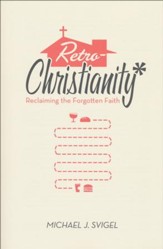
A few days ago, I finished reading Michael J. Svigel’s, Retro-Christianity – Reclaiming the Forgotten Faith (Google Books preview).

Joining a small, but growing number of evangelical writers, Svigel in this 2012 book, challenges his fellow evangelicals to explore the history of Christianity in a much fuller sense. He begins the book with a look back at the 1990’s when he, "was a student at a conservative evangelical Bible College" [p. 17], and relates that, “one of my fellow students shocked many in the student body (and alarmed many professors) when he announced he was becoming Greek Orthodox“ [p. 17]. He then. “heard about a free church evangelical who becames Anglican [p.17], and “about a Baptist who converted to Roman Catholicism” [p.17]. He also , “learned that many Low Church or free church Protestants hand left what they regarded as evangelical ‘wilderness wanderings’ to follow the 'Roman Road,’ the ‘Way to Constantinople,' or the ‘Canterbury Trail.’" "Over and over again”, Svigel “kept running into more examples like these: men and women leaving the open fields of of free roaming evangelicalism for the gated gardens of a clearly defined denomination" [pp. 17. 18].

Svigel goes on to identify three categories that these converts from  evangelicalism fell into: aversion-driven converts, attraction-driven converts, and preference-driven converts [p.18].

The aversion-driven converts are those who simply have had enough of of Low Church, free-church, or no-church evangelicalism" [p.18].

The attraction-driven converts...claim they were compelled to forsake their evangelical tradition because of their study of church history” [p.19].

Finally, the preference-driven converts are motivated not by the ills evangelicalism  or the merits of classic Christian denominations, but by personal preferences regarding worship” [p.19].

After stating that evangelicalism appears “to be spinning out of control, losing appeal to younger generations, dwindling in numbers, or selling out to pop culture to muster a crowd”, Svigel then asks two questions: “Where is evangelicalism headed? What can we do about it?" [Page 20]

The above questions are immediately followed with a detailed description of the intent/focus of the book—note the following:

This book will introduce to evangelicals the historical theological branches of the Christian faith that have grown through the Patristic, medieval, Reformation, and modern eras. RetroChristianity seeks to challenge us to begin thinking both critically and constructively about history and how it informs our current beliefs, values, and practices as evangelicals. However, unlike many attempts to change the present by looking to the past, this book also begins exploring practical ways for both individuals and churches to apply its principals today. Arguing that the way forward is to draw on the wisdom of the whole Christian past, RetroChristianity not only points out the trailhead of the biblical, historical, and theological path, but it supplies provisions for the journey without forsaking the healthy developments that have benefited Christianity along the way.

Svigel’s book is a multifaceted treatment. Though ultimately an apologetic work for independent/free church evangelicalism, it is also an introduction to the important topic of doctrinal development, and offers a working theory as to how one can identify true developments from false ones, using Vincent of Lérins famous ‘rule’—correct doctrine is “that faith which has which has been believed everywhere, always, by all”—as a starting point. Svigel interprets Vincent’s 'rule' as, "the core teachings of the Christian faith [that] must never change" [p. 55].

On pages 83-143 (Part Two: RetroOrtohoxy: Preserving the Faith for the Future), Svigel builds upon Vincent’s 'rule' with what he terms the three “Canons of RetroChristianity”. The first canon is: "Some Things Never Change and Never Should". The second is: "Some Things Have Never Been the Same and Never Will Be". And the third: "Some Things Grow Clear through Trial and Error".

I am sure most folk will agree with the stated principles of Svigel’s three canons. However, I am just as sure that most non-Evangelicals will disagree with much of the content that he places in each of those three canons.

On page 143, Svigel introduces the reader to “Part Three: RetroClesiology: Beyond the Preference Driven Church” [pages 145-218]—“With these three principles [i.e. the three canons] as our guide, we now can tackle two of the most vital areas affecting evangelicalism today: the church and the Christian life.

In "Part Three" Svigel identifies four "myths” concerning the Church: first, “The Church is Merely a Human Organization"; second, "The Church Is a Supermarket of Spiritual Groceries"; third, "The Church Is Just a Gathering of a Few Believers"; and fourth, “The Church Is Optional" [pages 146-162]. The four myths are then followed by the, “Four Classic Marks of the Historical Body of Christ”: "one, holy, catholic and apostolic” [pages 162-172].

Svigel’s definitions of "one, holy, catholic and apostolic” are all violations of Vincent’s ‘rule’ in that they have their origin in the 16th century via the Reformation and cannot be found in the extant Christian writings prior to that revolt.

On pages 173-198, Svigel delineates what he believes are the “essential marks” of a valid “local church: “orthodoxy, order, and ordinaces.” His understanding of what the mark of “order” means is one of the more interesting parts of the book for me, in that he seems to part with most evangelicals view. Svigel maintains, “that the leadership offices in the church established by the apostles must continue in our day” (page 178), and “that the New Testament apostles and prophets intended that local Christian churches reflect a threefold office later identified with the terms episkopos (overseer), presbyteroi (elders), diakonoi (ministers).” (Ibid.)

The final section of the book, “Part Four: RetroSpirituality: Living the Forgotten Faith Today” [pages 219-279] deals primarily with the local church’s role in the sanctification of Christians. For me, this is the most disappointing part of the book in that his evangelical understanding of soteriology has caused him to misread and/or redefine what Christian theologians/writers taught prior to the Reformation period. One example concerns baptism—note the following:

Let me make one final note regarding baptism in order to clarify a common misunderstanding. Although the idea of “baptismal regeneration" is universal among the early church fathers, it should not be confused with the notion of “baptismal salvation" common in later church history. In the early church, the term “regeneration" or being "born again" originally referred to a practical change in lifestyle. [Page 237]

Though Svigel is correct in affirming that, “the idea of ‘baptismal regeneration’ is universal among the early church fathers”, he is certainly in error in his belief that “[i]n the early church, the term ‘regeneration’ or being ‘born again’ originally referred to a practical change in lifestyle.

In ending my review, I would like to recommend Svigel's book to those interested in the subject of doctrinal development. Though the book has some serious weaknesses, its strengths outweigh them.


Grace and peace,

David

Friday, September 28, 2018

Unity and the Christian Church: Part 3b - the Catholic Tradition


In the combox of the previous thread here at AF, the Reformed Baptist, Ken Temple, raised some concerns about Irenaeus', Proof/Demostration of the Apostolic Preaching. Ken wrote:

the parts about baptism that you brought out from "the Proof of the Apostolic Preaching" (found in recent years from an Armenian copy, right? - not found in the Philip Schaff collection of EFC) - could they not be interpreted in the way that we usually handle Acts 2:38 and Titus 3:5 ? (link)

Ken is correct that the Proof/Demonstration of the Apostolic Preaching is not found in the Ante-Nicene Fathers series edited by Philip Schaff, and that the four English translations I am aware of are based on an Armenian manuscript discovered in 1904. Note the following from CCEL Staff Writer, Emmalon Davis:

Demonstration of the Apostolic Preaching is a second century guide for Christian converts. After disappearing for nearly two millennia, an Armenian copy of St. Irenaeus' guidebook was discovered in 1904. Current versions of this ancient text have been translated from the Armenian, a language which greatly resembles the Greek in which it was originally transcribed. St. Irenaeus wanted to set out the main points of the Apostolic message, which was handed down to the Church from Old Testament Scriptures. St. Irenaeus explains the doctrine of Christianity as it was understood by the educated believers of his day. He defends the grounds of belief and aims to demonstrate the truth of the ancient Biblical prophecy. As a result, his project is both theological and historical. Even today, St. Irenaeus' book of guidelines serves to help Christians find salvation and refute heretics. (LINK)

I am not aware of any published Patristic scholar—e.g. John Behr, Everett Ferguson, J. N.D. Kelly, John Lawson, Iain M. MacKenzie, J. Armitage Robinson, Joseph P. Smith—who references the Proof/Demonstration of the Apostolic Preaching, that has questioned the authenticity and/or reliability of the Armenian manuscript. I concur with Dr. Joseph P. Smith, who wrote:

AUTHENTICITY. That the work here presented to us is really, as the manuscript describes it, the "Proof of the Apostolic Preaching" of Irenaeus, is certain on internal grounds. The title and the name (chapter 1) of the addressee agree with the information given us by Eusebius; the work reflects the conditions of the end of the second century, and its manner and many of its turns of expression agree with Irenaeus's known writings, and with his views and preoccupations; the parallels with Adversus haereses are many and striking... (Irenaeus, Proof of the Apostolic Preaching, trans. by Joseph P. Smith, S.J., Newman Press, pp. 5, 6.)

Now, Ken seems to question the authenticity of the Proof/Demonstration of the Apostolic Preaching because of its description concerning the nature of Christian baptism (Ken, please correct me on this if I have misunderstood you). Note the following:

THE RULE OF FAITH

3. So, lest the like befall us, we must keep strictly, without deviation, the rule of faith, and carry out the commands of God, believing in God, and fearing Him, because He is Lord, and loving Him, because He is Father. Action, then, is preserved by faith, because unless you believe, says Isaias, you shall not continue; and faith is given by truth, since faith rests upon reality: for we shall believe what really is, as it is, and, believing what really is, as it is for ever, keep a firm hold on our assent to it. Since, then, it is faith that maintains our salvation, one must take great care of this sustenance, to have a true perception of reality. Now, this is what faith does for us, as the elders, the disciples of the apostles, have handed down to us. First of all, it admonishes us to remember that we have received baptism for the remission of sins in the name of God the Father, and in the name of Jesus Christ, the Son of God, who became incarnate and died and raised, and in the Holy Spirit of God; and that this baptism is the seal of eternal life and is rebirth unto God, that we be no more children of mortal men, but of the eternal everlasting God; and that the eternal and everlasting One is God, and is above all creatures, and that all things whatsoever are subject to Him; and that what is subject to Him was all made by Him; so that God is not ruler and Lord of what is another’s, but of His own, and all things are God’s; that God, therefore, is the Almighty, and all things whatsoever are from God.
(Irenaeus, Proof of the Apostolic Preaching, trans. by Joseph P. Smith, S.J., Newman Press, pp. 49, 50 - bold emphasis mine.)

Keeping in mind Dr. Smith's assessment that, "the parallels with Adversus haereses are many and striking", one should expect to find "baptism for the remission of sins" and baptism as, "rebirth unto God" (i.e. regeneration). One clearly finds such parallels in Irenaeus' Against Heresies (bold emphasis in the following quotes is mine):

1. It happens that their tradition respecting redemption is invisible and incomprehensible, as being the mother of things which are incomprehensible and invisible; and on this account, since it is fluctuating, it is impossible simply and all at once to make known its nature, for every one of them hands it down just as his own inclination prompts. Thus there are as many schemes of “redemption” as there are teachers of these mystical opinions. And when we come to refute them, we shall show in its fitting-place, that this class of men have been instigated by Satan to a denial of that baptism which is regeneration to God, and thus to a renunciation of the whole [Christian] faith.

2. They maintain that those who have attained to perfect knowledge must of necessity be regenerated into that power which is above all. For it is otherwise impossible to find admittance within the Pleroma, since this [regeneration] it is which leads them down into the depths of Bythus. For the baptism instituted by the visible Jesus was for the remission of sins... (Against Heresies, 1.21.1, 2a - ANF 1.345)

But it is evident from Peter's words that he did indeed still retain the God who was already known to them ; but he also bare witness to them that Jesus Christ was the Son of God, the Judge of quick and dead, into whom he did also command them to be baptized for the remission of sins; and not this alone, but he witnessed that Jesus was Himself the Son of God, who also, having been anointed with the Holy Spirit, is called Jesus Christ. (Against Heresies, 3.12.7 - ANF 1.443)

And inasmuch as man, with respect to that formation which was after Adam, having fallen into transgression, needed the laver of regeneration, [the Lord] said to him [upon whom He had conferred sight], after He had smeared his eyes with the clay, "Go to Siloam, and wash ;"  thus restoring to him both [his perfect] confirmation, and that regeneration which takes place by means of the laver. And for this reason when he was washed he came seeing, that he might both know Him who had fashioned him, and that man might learn [to know] Him who has conferred upon him life. (Against Heresies, 5.15.3 - ANF 1.543)

Before ending, I would like to provide a selection from the esteemed Lutheran scholar, R. C. H. Lenski, who I believe does an excellent job in addressing how one is to interpret Acts 2:38, which is directly germane to Irenaeus' understanding of "baptism for the remission of sins":

Baptism is pure that conveys grace and salvation from God through Christ: it dare not be changed into a legal or legalistic requirement that is akin to the ceremonial requirement of Moses such as circumcision. God does something for us in baptism, we do we do nothing for him. Our acceptance of baptism is only acceptance of God's gift.

This is emphasized strongly in the addition: "for or unto remission of your sins." It amounts to nothing more than a formal grammatical difference whether εἰς is again regarded as denoting sphere (equal to ἐν), R. 592, or, as is commonly supposed, as indicating aim and purpose, R. 592, as better still as denoting effect. Sphere would mean that baptism is inside the same circle as remission; he who steps into this circle has both. Aim and purpose would mean that baptism intends to give remission; in him, then, who receives baptism aright this intention, aim, and purpose would be attained. The same is true regarding the idea of effect in εἰς this preposition connects remission so closely with baptism that nobody has as yet been able to separate the two. It is this gift of remission that makes baptism a true sacrament; otherwise it would be only a sign or a symbol that conveys nothing real. (R. C. H. Lenski,  The Interpretation of the Acts of the Apostles, pp. 107, 108.)

A few sentences later, Dr. Lenski then asked the following question:

And how can Ananias in 22:16 say, "Be baptized and wash away thy sins!" as though the water of baptism washed them away by their connection with the Name? (R. C. H. Lenski, The Interpretation of the Acts of the Apostles, pp. 107, 108.)

Shall end here for now. Hope to have part 4 of this series ready for posting early next week.


Grace and peace,

David

Friday, March 3, 2017

Infant salvation: the Lutheran tradition


This fourth installment of my continuing series on INFANT SALVATION, will examine the conservative Lutheran position, as delineated by Charles Porterfield Krauth. C. P. Krauth was a conservative, 19th century, American Lutheran scholar. I first became aware of Krauth after purchasing his massive book, The Conservative Reformation and Its Theology (Augsburg Publishing House, 1963 reprint edition), back in 1990s during one of my frequent visits to Powell's Books. The back-flap of the book's dust cover has the following to say about the author:

Charles Porterfield Krauth, 1823-1883, was a parish pastor, teacher, editor, church leader and champion of conservative Lutheranism in America . . . regarded by many as the most eminent Lutheran in America of the 19th century. Through his recognized ability as a public speaker and with his prolific pen—particularly with this volume, considered his magnum opus—he set the stamp of his own theology upon a whole generation and more of American Lutheran ministers. (An in depth, two volume biography is available in an online PDF version, here.)

Krauth's thoughts on infant salvation are referenced in his aforementioned book. The following selections from this contribution will be from the 1875 edition, Google Books PDF version (LINK).

Krauth's theological reflections on infant salvation are inextricably linked to the early Lutheran understanding of the doctrine of 'original sin,' as delineated in the original Augsburg Confession. From Krauth's book we read:

The Article teaches us what original sin would do if there were no redemption provided in Christ. The mere fact that Christ has wrought out His work provides a sufficient remedy, if it be applied, to save every human creature from the effects of original sin. Let not this great fact be forgotten. Let it never be left out of the account in looking at the mystery of original sin, that there is an ample arrangement by which the redemption of every human creature from the results of original sin could be effected ; that there is no lack in God's provision for saving every one of our race from its results. "Our Lord Jesus Christ, by the grace of God, tasted death for every man."

2. It is not the doctrine of our Confession that any human creature has ever been, or ever will be, lost purely on account of original sin. For while it supposes that original sin, if unarrested, would bring death, it supposes it to be arrested, certainly and ordinarily, by the Holy Spirit, through the divine means rightly received, and throws no obstacle in the way of our hearty faith that, in the case of infants dying without the means, the Holy Ghost, in His own blessed way, directly and extraordinarily, may make the change that delivers the child from the power of indwelling sin. Luther, in his marginal note on John xv. 22, says: "Denn durch Christum ist die Erbsünde auffgehaben, und verdamnet nach Christus zukunfft niemand. On wer sie nicht lassen, das ist, wer nicht glenben wil." "Through Christ original sin is annulled, and condemneth no man since Christ's coming, unless he will not forsake it (original sin), that is, will not believe." (Pages 428, 429 - bold emphasis mine.)

Over the next couple of pages, Krauth cites Luther and other early Lutheran theologians concerning the necessity of baptism for salvation. It is deduced that baptism is necessary only when it, "refers to the ordinary mode which God observes in saving men", and that,  "the matter is different in a case of necessity, when any one cannot obtain it" (p. 430).

Krauth then writes:

Both Luther and Bugenhagen discuss at large the argument for, and objections against, the doctrine of the salvation of unbaptized little children, and demonstrate that it is no part of the faith of our Church, that Baptism is absolutely necessary : that is, that there are no exceptions or limitations to the proposition that, unless a man is born again of the Water of Baptism, he cannot enter into the kingdom of God.

Luther and Bugenhagen condemn those who refuse to unbaptized children the rites of Christian burial, and who object to laying their bodies in consecrated ground, as if they were outside of the Church. "We bury them," say they, "as Christians, confessing thereby that we believe the strong assurances of Christ. The bodies of these unbaptized children have part in the joyous resurrection of life." (Pages 432, 433 - bold emphasis mine.)

Earlier in his work, Krauth lists this issue of baptism as one of the doctrines in which the Lutheran Church, "has been mispresented" (p. 129), and then writes:

Baptism. The Lutheran Church holds that it is necessary to salvation to be born again of water (baptism) and the Spirit, (John iii. 5, and Augsburg Confession, Art. II. and IX. ;) but she holds that this necessity, though absolute as regards the work of the Spirit, is, as regards the outward part of baptism, ordinary, not absolute, or without exception ; that the contempt of the sacrament, not the want of it, condemns ; and that though God binds us to the means, he does not bind his own mercy by them. From the time of Luther to the present hour, the Lutheran theologians have maintained the salvability and actual salvation of infants dying unbaptized. (Page 129 - bold emphasis mine.)

I will conclude this post with Krauth's following portrayal—and contrasts—of the Lutheran position on infant salvation:

The truth is, no system so thoroughly as that of the Lutheran Church places the salvation of infants on the very highest ground.

The Pelagian system would save them on the ground of personal innocence, but that ground we have seen to be fallacious. The Calvinistic system places their salvation on the ground of divine election, and speaks elect infants, and hence, in its older and more severely logical shape at least, supposed not only that some unbaptized, but also that some baptized infants are lost. (Page 434.)


Grace and peace,

David

Wednesday, March 4, 2015

The Reformed tradition and baptismal efficacy/regeneration


Yesterday, I received an email from one follower of AF asking for examples of "Reformed folk" who hold to some form of baptismal regeneration (i.e. that baptism is an efficacious means of grace). His question was prompted by the following that I wrote back on 09-11-14:

It is important to keep in mind that those who embrace baptismal regeneration (in one form or another—e.g. Catholics, the Eastern Orthodox churches, Lutherans, many Anglicans, and some Reformed folk), adamantly maintain that it is means of grace...(link to thread)

In my reply, I suggested that he read the following online essays by Rich Lusk:


This morning, I realized that I forgot to mention William B. Evans excellent article:

“Déjà Vu All Over Again?: The Contemporary Reformed Soteriological Controversy in Historical Perspective,” Westminster Theological Journal 72.1 (2010): 135-151.

The essay is not available online, but back on 05-31-10, I provided some lengthy selections from it in THIS THREAD.

In ending, I cannot help but believe that anyone who takes the time to read the above four essays will come to the conclusion that there are (and have been) "some Reformed folk" who embrace baptismal regeneration in "one form or another".


Grace and peace,

David

Sunday, October 19, 2014

Timothy Kauffman on baptismal regeneration and the early Church Fathers: my critical examination continues


This post has been delayed by almost a month. Rather than bore readers with all that transpired during the last few weeks, I shall proceed right into the main emphasis of this thread—Timothy Kauffman's novel interpretations concerning baptismal regeneration and the early Church Fathers.

Tim (I will be referring to Timothy as Tim throughout the rest of this post, not out disrespect, but due to the fact that in our combox interactions, he refers to himself as such, so I am assuming that this is his preference) has published the final installment (#6) in his ongoing series, "THAT HE MIGHT PURIFY THE WATER" (link).

The following is the second paragraph of Tim's final installment:

Before we proceed with Methodius of Olympus, the last Ante-Niceæan Father cited by Called to Communion, we thought it would be worthwhile to interact very briefly with David Waltz who blogs at Articuli Fidei and has also commented at this site as well. We appreciate Waltz’s interaction and his willingness to engage on this topic.

Before moving on to Tim's reflections, I would like to say that I too appreciate Tim's, "interaction and his willingness to engage on this topic." Though I have grave concerns concerning a number of his novel interpretations of the early Church Fathers concerning baptism (and as you will see, his take on Dr. Ferguson), I sincerely appreciate the fact that he has been very charitable with me in our discussions, even though I have been quite critical at times. (I also appreciate the fact he has adopted a open policy when it comes to comments on his blog, a policy I firmly believe in, and employ here at AF).

Tim continued his post with:

Waltz responded to our posts, analyzed two fathers that we cited, and concluded that we were really “0 for 2″ in our analysis thus far, due in no small part to his reliance on Dr. Everett Ferguson’s Baptism in the Early Church.  Waltz wrote here last week that Ferguson “is one of the (if not THE) foremost authorities on the NT and early [Church Fathers] teachings concerning baptism,” and thought that “perhaps [we] would not so easily dismiss” him.

I must correct Tim here, my conclusions concerning Justin Martyr and Tertullian were NOT, "due in no small part to his reliance on Dr. Everett Ferguson’s Baptism in the Early Church", but rather, "due in no small part" to my own readings of their contributions on baptism. I cited Dr. Ferguson primarily for three reasons: first, because his assessments mirror my own; second, he is a contemporary patristic scholar, who has done extensive work on the topic of baptism in the early Church Fathers; and third, his reflections are representative of pretty much every patristic scholar who has written on the subject.

Tim then wrote:

But we do dismiss Ferguson, and we do so advisedly. There is very much we could write on this, but we will give only a few examples to make our point. Ferguson’s work is helpful as a resource, but it simply cannot be the final say on baptism in the fathers.

I agree with Tim that, "Ferguson’s work is helpful as a resource, but it simply cannot be the final say on baptism in the fathers"; however, I do not dismiss him as easily (so it seems) as Tim does. Tim goes on to offer a few examples of where he differs with Dr. Ferguson (which I hope to address in upcoming posts), but for now, I would like to explore some of Tim's presuppositions;  presuppositions which I believe have caused Tim to grossly misread the Church Fathers when it comes to the doctrine of baptismal regeneration.

One of Tim's presuppositions is: if a Church Father postulates that regeneration/new birth can occur apart from the sacrament of baptism, then that Church Father cannot believe in baptismal regeneration

Tim has committed a grave error here: the fact that God can, and does, provide other means than the sacrament of baptism to regenerate some of His children does not negate that one can still consistently believe that the sacrament of baptism is the ordinary means by which God regenerates.

A second presupposition which leads Tim to incorrect assessments of the Church Fathers is: if baptism is referred in figures and/or as a sign and seal, then that Church Father cannot also believe in baptismal regeneration.

Once again, such beliefs do not negate that one can also maintain the sacrament of baptism is the ordinary means by which God regenerates. Augustine, Aquinas, Trent and the Catechism of the Catholic Church (to name but a few germane sources within the Catholic tradition), like Tertullian, all affirm that God has provided other means than the sacrament of baptism for the new birth. They use a number of figures when referencing baptism, calling baptism both a sign and a seal, and they do this while also clearly affirming that the sacrament of baptism in the ordinary means that God regenerates.

There is a third presupposition embraced by Tim, which may be the most detrimental one: his belief that the great apostasy spoken of in the NT occurred in the late 4th century.

Tim adamantly maintains that belief in baptismal regeneration is one of the outcomes of this supposed late 4th century apostasy; as such, Tim cannot allow a reading of any of the Church Fathers who wrote prior to this alleged apostasy which would suggest that they believed in baptismal regeneration, for such a reading would force him to jettison his cherished presupposition.

Armed with such presuppositions, one should not be surprised that Tim has developed interpretations of the Church Fathers concerning baptismal regeneration that are novel, and void of any support from patristic scholars.

Moving on, over the last couple of days, I have been rereading all of Tim's selections from the writings of Tertullian, and his novel interpretations of those passages. I have also reread a number of English translations of Tertullian's On Baptism, On Repentance, Against Marcion, and a few other passages that touch on baptism, consulting the Latin where the translations vary. I have come away from these fresh readings even more convinced than before that Tim has made some grave errors in his interpretations of Tertullian; Tim's novel interpretations just don't hold up when one reads Tertullian's writings in their full context.

Since I have already examined the concepts of 'baptism of blood' and 'baptism of desire/repentance' in two previous threads (first; second)—reiterating that belief in such concepts do not preclude one from also believing that the sacrament of baptism is the ordinary means that God uses to regenerate fallen mankind—I would now like to explore what I believe to be is the most important issue at hand: did Tertullian in his writings affirm that the sacrament of baptism regenerates ???

Even though Tim admitted that, "Tertullian spends 20 chapters defending the merits of baptism, its divine origin, the significance of the water, the power to sanctify, remit sins, grant life and secure eternal salvation", he then goes on to deny that such a defense includes the belief that the sacrament of baptism itself is the ordinary means which brings those graces to fruition. He argues that one should not adopt a "plain" reading of Tertullian here because, "Tertullian says more than this".

I ask: does Tertullian's non-"plain" musings negate his "plain" statements on this matter ??? Tim says yes, but I (and pretty much every patristic scholar I have read) say no. Interestingly enough, Tertullian himself castigates the heretic Marcion for negating the belief that the sacrament of baptism truly accomplishes what it is said to bring about. Note the following:

I see no coherence and consistency; no, not even in the very sacrament of his faith [i.e. baptism] ! For what end does baptism serve, according to him ? If the remission of sins, how will he make it evident that he remits sins, when he affords no evidence that he retains them? Because he would retain them, if he performed the functions of a judge. If deliverance from death, how could he deliver from death, who has not delivered to death ? For he must have delivered the sinner to death, if he had from the beginning condemned sin. If the regeneration of man, how can he regenerate, who has never generated ? For the repetition of an act is impossible to him, by whom nothing anytime has been ever done. If the bestowal of the Holy Ghost, how will he bestow the Spirit, who did not at first impart the life ? For the life is in a sense the supplement of the Spirit. He therefore seals man, who had never been unsealed in respect of him ; washes man, who had never been defiled so far as he was concerned ; and into this sacrament of salvation wholly plunges that flesh which is beyond the pale of salvation ! (Against Marcion, 1.28 - ANF volume 3.293.)

Tertullian clearly establishes that one should embrace a "plain" reading of his views on the sacrament of baptism, contrary to what Tim would have us to believe.

I would now like to address Tim's claim, "that the water of the baptismal font is merely a signification of the actual baptism that takes place in the heart."

Tim wrote:

Notice, for example, that Tertullian was so free in his use of figures that he actually has us drinking from the baptismal font unto eternal life. If taken literally, this is a divergence from the command of Christ, for He did not command that we “take and drink” the water of baptism. But if Tertullian is to be taken figuratively—as well he should—the water of baptism that we are to drink is the Word of God and the truth of Christ’s Passion, which revives us, which is to say, regenerates us. This Tertullian plainly states:

“For this tree in a mystery, it was of yore wherewith Moses sweetened the bitter water; whence the People, which was perishing of thirst in the desert, drank and revived; just as we do, who, drawn out from the calamities of the heathendom in which we were tarrying perishing with thirst (that is, deprived of the divine word), drinking, by the faith which is on Him, the baptismal water of the tree of the passion of Christ, have revived—a faith from which Israel has fallen away, ….” (Tertullian, An answer to the Jews, 13)

Note once again that we have a Church Father referring to Christ’s Passion as the “baptismal water,” or the laver of revivification, as it were. This is important because next we shall see that Tertullian insisted that the literal water of baptism ought not be approached until the spiritual water of baptism is already evident in the believer.

Take notice of what Tim is doing in his above interpretation: he is replacing "the baptismal water of the tree of the passion of Christ" with "Christ's Passion as [is] the 'baptismal water'". The "drinking" is no longer a metaphor for the sacrament of baptism (i.e. "the baptismal water"), but has now become solely faith in "Christ's passion". Tim has erroneously gotten rid of the efficacy of the sacrament of baptism, one of the, "two baptisms He sent out from the wound in His pierced side", mentioned by Tertullian in his On Baptism (chapter 16). The "baptismal water" (i.e. sacrament of baptism) is efficacious THROUGH "the tree of the passion of Christ", for "Christ [is], the 'font of the water of life'." From Christ's Passion comes "the water of life"; "the water of life" is not Christ's Passion itself, but flows out from His Passion, Christ being the "font".

Tim also replaced the evidence of true repentance on the part of the believer, with "the spiritual water of baptism", arguing that Tertullian's admonition to postpone the sacrament of baptism until there is solid evidence of true repentance, supports this replacement. This cleaver attempt is flawed, for if Tertullian thought that the sacrament of baptism was merely a "sign" and/or "seal" of something that had already taken place (in other words, the sacrament of baptism has no efficacious effect/s), why such stern warnings from Tertullian ? Fact is, Tertullian argued for the postponement of sacramental baptism because he believed that the effects produced by the sacrament of baptism (e.g. regeneration, forgiveness of sins, union with Christ, et al.) occurs only once. The effects of sacrament of baptism can be lost through post-baptismal sin—i.e. one who has been regenerated through baptism can become unregenerate through sin. And further, Tertullian believed that some post-baptismal sins are unforgivable (e.g. adultery, apostasy, murder), so he wanted to make sure that anyone who submitted to baptism had truly repented of their sins. In other words, Tertullian was not a Calvinist.

However, Tertullian did have a great deal in common with Thomas Aquinas. Like Aquinas, Tertullian believed that the sacrament of baptism regenerated; like Aquinas, he held that the sacrament of baptism receives it's efficacy from Christ's Passion; like Aquinas, he maintained that one could become unregenerate by post-baptismal sin; like Aquinas, he affirmed two other means than the sacrament of baptism by which one can be born-again—i.e. baptism of blood and baptism of repentance. (See appendix below for Aquinas' reflections.)

I sincerely doubt that Tim will jettison his novel interpretations of Tertullian, for I believe that his presuppositions will continue to prevent him from reading Tertullian in a "plain" sense, the very sense that Tertullian himself has asked his readers to embrace when it comes to the sacrament of baptism.

Shall end with a "plain" quote from Tertullian:

Now there is a standing rule that without baptism no man can obtain salvation. It derives in particular from that (well known) pronouncement of our Lord, who says, Except a man be born of water he cannot have life(On Baptism, 12.1)


Grace and peace,

David


Appendix: Thomas Aquinas Summa Theologica Part 3, Q. 66, Art. 11

On the contrary, on Heb. 6:2, Of the doctrine of Baptisms, the gloss says : He uses the plural, because there is Baptism of Water, of Repentance, and of Blood.

  I answer that, As stated above (Q. 62, A. 5), Baptism of Water has its efficacy from Christ's Passion, to which a man is conformed by Baptism, and also from the Holy Ghost, as first cause. Now although the effect depends on the first cause, the cause far surpasses the effect, nor does it depend on it. Consequently, a man may, without Baptism of Water, receive the sacramental effect from Christ's Passion, in so far as he is conformed to Christ by suffering for Him. Hence it is written (Apoc. vii. 14) : These are they who are come out of great tribulation, and have washed their robes and have made them white in the blood of the Lamb. In like manner a man receives the effect of Baptism by the power of the Holy Ghost, not only without Baptism of Water, but also without Baptism of Blood: forasmuch as his heart is moved by the Holy Ghost to believe in and love God and to repent of his sins: wherefore this is also called Baptism of Repentance. Of this it is written (Isa. iv. 4) If the Lord shall wash away the filth of the daughters of Zion, and shall wash away the blood of Jerusalem out of the midst thereof, by the spirit of judgment, and by the spirit of burning. Thus, therefore, each of these other Baptisms is called Baptism, forasmuch as it takes the place of Baptism. Wherefore Augustine says (De Unico Baptismo Parvulorum iv) : The Blessed Cyprian argues with considerable reason from the thief to whom, though not baptized, it was said: "Today shalt thou be with Me in Paradise" that suffering can take the place of Baptism. Having weighed this in my mind again and again, I perceive that not only can suffering for the name of Christ supply for what was lacking in Baptism, but even faith and conversion of heart, if perchance on account of the stress of the times the celebration of the mystery of Baptism is not practicable.

 Reply to Obj. 1.  The other two Baptisms are included in the Baptism of Water, which derives its efficacy, both from Christ's Passion and from the Holy Ghost. Consequently for this reason the unity of Baptism is not destroyed.


  Reply to Objection 2.  As stated above (Q. 60, A. 1), a sacrament is a kind of sign. The other two, however, are like the Baptism of Water, not, indeed, in the nature of sign, but in the baptismal effect. Consequently they are not sacraments.

  Reply to Objection 3.  Damascene enumerates certain figurative Baptisms. For instance, the Deluge was a figure of our Baptism, in respect of the salvation of the faithful in the Church; since then a few . . . souls were saved in the ark [Vulg.: 'by water'], according to 1 Pt. 3:20. He also mentions the crossing of the Red Sea : which was a figure of our Baptism, in respect of our delivery from the bondage of sin; hence the Apostle says (1 Cor. x. 2) that all . . . were baptized in the cloud and in the sea. And again he mentions the various washings which were customary under the Old Law, which were figures of our Baptism, as to the cleansing from sins: also the Baptism of John, which prepared the way for our Baptism. (Summa Theologica, Pt. III, Q. 66. A. 11; CHRISTIAN CLASSICS - Complete English Edition in Five Volumes, Translated by the Fathers of the English Dominican Province, 1911, 1948, 1981, IV. pp. 2384, 2385—html version available online link.)
Monday, September 15, 2014

Tertullian and the 'baptism of blood'


Earlier today, I noticed that Mr. Kauffman has published a 5th installment in his ongoing series, "THAT HE MIGHT PURIFY THE WATER" (link). In the combox of that thread, Mr. Kauffman denies that one the two baptisms (i.e. baptism of blood) mentioned in chapter 16 of De Baptismo has martyrdom in mind. Mr. Kauffman wrote:

When Tertullian says, “called by water, chosen by blood. … in order that they who believed in His blood might be bathed with the water” there simply is no justification for interpreting this to be a reference to a martyr’s death. The baptism of blood is clearly “belief in his blood,” and this stands in lieu of the fontal bathing when that has not been received.

Dr. Everett Ferguson understands chapter 16 differently than Mr. Kauffman; note the following:

An important modification to the normal necessity of water baptism applied to the times of persecution. Using Christ's comparison of his death with baptism (Luke 12:50), Tertullian says, "We have a second washing (lavacrum), it too a single one, that of blood" (Baptism 16.1). Appealing to 1 John 5:6 and the water and the blood that came from Jesus' side (John 19:34), he adds: "[The Lord] sent forth these two baptism from out of the would of his pierced side," one a washing in water and the other in blood. Blood shed in martyrdom "makes actual a washing which has not been received, and gives back again one that has been lost" by postbaptismal sin (16.1-2). (Baptism In The Early Church, p. 349)

Dr. Ferguson provides a footnote to this section (#46), wherein he writes:

46. Modesty 12 also describes martyrdom as "another baptism" to which Jesus referred in Luke 12:50, and interprets the water and the blood from Jesus' side as the materials of the two baptisms. Scorpiace 12.10 says, "Baptism washes away filth, but martyrdom makes stains truly white." (Ibid.)

Tertullian, in his Apology, penned the now famous phrase, "the blood of the Christians is seed" (chapter 50, English trans. by Thelwall, in ANF 3.55).

And just a bit later he states:

...who, after inquiry, does not embrace our doctrines ? and when he has embraced them, desires not to suffer that he may become partaker of the fulness of God's grace, that he may obtain from God complete forgiveness, by giving in exchange his blood For that secures the remission of all offences. (Ibid.)

Hmmm...so the baptism of blood, is NOT "a reference to a martyr’s death" ???  I think I will side with the esteemed patristic scholar, Dr. Ferguson, on this, rather than Mr. Kauffman's highly questionable interpretation.


Grace and peace,

David

Saturday, September 13, 2014

Baptismal regeneration and the early Church Fathers: Tertullian


In this ongoing series on baptismal regeneration and the early Church Fathers (using Mr. Kauffman's attempted rebuttals of Dr. Cross as an introduction of sorts), I am jumping from Justin Martyr to Tertullian (I will examine a few of the CFs between these two in upcoming posts), for the following reason: of all the early CFs who explore the issue of baptism in any depth, Tertullian is the only one who, on the surface, appears to create some difficulties for those who maintain that baptismal regeneration was a consensus teaching among the early Church Fathers.

Mr. Kauffman begins his rebuttal of Dr. Cross's assessment of Tertullian (link), with the following:

The citations that Called to Communion uses from Tertullian’s On Baptism here are too numerous to include, though we encourage our readers to examine them all. Better yet, to read Tertullian’s entire treatise, On Baptism. We have included only one citation, above, so our readers can at least get a taste of Tertullian’s writing, and Called to Communion‘s evidence from him.

On Baptism was written in response to the “viper of the Cainite heresy, lately conversant in this quarter, [which] has carried away a great number with her most venomous doctrine, making it her first aim to destroy baptism” (Tertullian, On Baptism, chapter 1). Tertullian spends 20 chapters defending the merits of baptism, its divine origin, the significance of the water, the power to sanctify, remit sins, grant life and secure eternal salvation. Here Called to Communion seems to have read Tertullian for what he plainly says as he implores Christians, with soaring rhetoric and impassioned reasoning, not to dispense with a command of Christ by stumbling into the Cainite heresy.

So far, so good. Mr. Kauffman has done a pretty good job of summarizing the content of Tertullian's treatise, De Baptismo (though he did leave out two important aspects of "the merits of baptism" included by Tertullian: rebirth, and the necessity of baptism for salvation).

[NOTE: For online texts and resources concerning Tertullian, I highly recommend THIS WEBSITE.]

He then writes:

But Tertullian says more than this, and we find that he knew very well that the power of regeneration emanates from the Cross, and that baptism, the baptism of the Cross, “stands in lieu of the fontal bathing”:

“These two baptisms He sent out from the wound in His pierced side, in order that they who believed in His blood might be bathed with the water; they who had been bathed in the water might likewise drink the blood. This is the baptism which both stands in lieu of the fontal bathing when that has not been received, and restores it when lost.” (Tertullian, On Baptism, Chapter 16)

Even here in On Baptism, Tertullian is tipping his hand, and showing that his own soaring rhetoric is hyperbolic, and he hints at his conviction (which he elsewhere states explicitly) that the water of the baptismal font is merely a signification of the actual baptism that takes place in the heart.

Rather than, "tipping his hand, and showing that his own soaring rhetoric is hyperbolic", Tertullian is here mentioning (without an in depth analysis) the Catholic concept of 'baptism of blood'; note the following:

Baptism of blood is the martyrdom of an unbaptized person that, because of the patient acceptance of a violent death or an attack leading to death, constitutes the confessing of the Christian faith or the practice of Christian virtue. Christ himself contended that martyrdom, like perfect love, contains justifying power (e.g. Mt 10:32, 10:39; Jn 12:25). Fathers of the Church, namely Tertullian and St. Cyprian, regarded martyrdom as a legitimate substitute for sacramental baptism. (Our Sunday Visitor's Encyclopedia of Catholic Doctrine, 1997, p. 47.)

Mr. Kauffman sure seems to be either ignorant of the fact that Catholic dogma does not limit the means of salvation to sacramental baptism only, or he is purposefully being deceptive here. In fact, all of his arguments against Tertullian affirming baptismal regeneration proceed under the assumption that Catholicism teaches sacramental baptism is the only means by which one can be saved. Mr. Kauffman's remaining arguments are quite easily deflected if one keeps in mind that 'baptism of blood' and 'baptism of desire' are viable options for salvation within Catholic thought.

So, the question that needs to asked is not whether Tertullian believed that salvation can take place apart from sacramental baptism, but rather, whether or not Tertullian's teaching on sacramental baptism is best described as baptismal regeneration. An objective reading of Tertullian's take sacramental baptism clearly reveals that his view falls under the rubric of baptismal regeneration. Since even Mr. Kauffman himself affirms that Tertullian in his De Baptismo, "spends 20 chapters defending the merits of baptism, its divine origin, the significance of the water, the power to sanctify, remit sins, grant life and secure eternal salvation", to which one should add rebirth and the necessity of baptism for salvation, the affirmation that Tertullian taught the doctrine of baptismal regeneration is the only accurate conclusion that one can maintain.

The patristic scholar, Dr. Everett Ferguson, confirms this conclusion; note the following:

Tertullian summarizes the doctrine of baptism in listing the items that he found inexplicable if one accepted Marcion's teachings: remission of sins, deliverance from death, regeneration (regeneratio), and bestowal of the Holy Spirit (Against Marcion 1.28.2-3)...

Tertullian most often expresses the significance of baptism in terms of forgiveness or cleansing from sins...

Tertullian further associated baptism with regeneration and new birth...

These benefits attributed to baptism underscores its necessity. Tertullian declares that "it is prescribed that without baptism no person can obtain salvation" (Baptism 12.1.) This standing rule derives from the Lord's pronouncement in John 3:5, "Except one be borm of water he cannot have life." Shortly thereafter Tertullian quotes both Matthew 28:19 and John 3:5 (this time more fully and more accurately) in support of the necessity of baptism. (Baptism in the Early Church, 2009, pp. 346, 347, 349.)

Contra Mr. Kauffman's view that Tertullian did not teach baptismal regerneration, we see just the opposite. So far in our examination of Mr. Kauffman's rebuttals, we find that he is zero for two. In the next installment of this series, we will look at Irenaeus (the Lord willing).


Grace and peace,

David